
Bulguksa Temple, Geyongju, Korea
- Medium:
- Mokuhanga (Japanese woodblock)
- Image courtesy of
- Saru Gallery
Description
Bulguksa, the eighth-century Silla-era temple in Gyeongju, was a frequent subject for Japanese artists working in Korea during the colonial period and continued to attract postwar travelers. Sekino's print extends his architectural series beyond Japan, treating the granite stairways, stone pagodas (Dabotap and Seokgatap), and tiled wooden halls of the compound. Compositions of this type typically organize the temple's stepped stone foundations into strong horizontal bands, with the verticals of the pagodas providing counterweight. Sekino's handling of stone surfaces — built from layered grey impressions with subtle bokashi — differs markedly from his treatment of Japanese temple woodwork, registering the harder, more weathered character of Korean granite. The print belongs to the broader travel-subject vein within sosaku-hanga, where artists used foreign sites to test the medium's range while maintaining the movement's commitment to artist-carved, artist-printed production.
More Prints by Jun'ichiro Sekino
More Temples & Shrines Prints
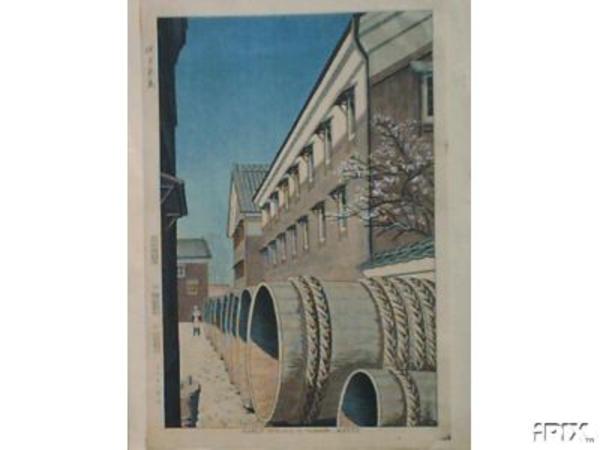
Fushimi Inari Temple
伏見稲荷
Woodblock print

The Compound of the Tenman Shrine at Kameido in the Snow (Kameido Tenmangu keidai no yuki), from the series "Famous Places in the Eastern Capital (Toto meisho)"
c. 1832/38
Color woodblock print; oban
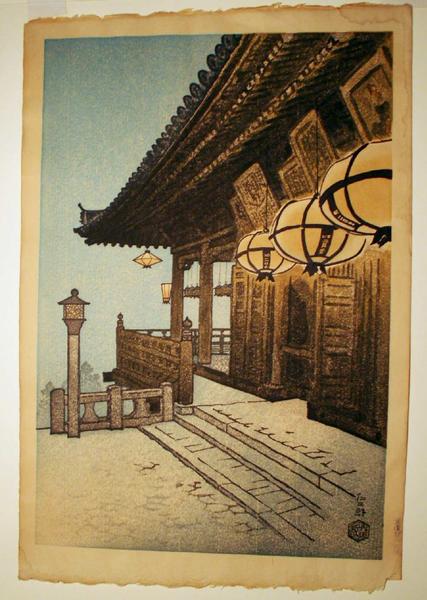
Temple with lanterns
Woodblock print

A Section of the Byodo Temple at Uji (Uji Byodoin no ichibu), from the series "Souvenirs of Travel, Second Series (Tabi miyage dai nishu)"
Uji Byodoin no ichibu
1921
Color woodblock print; oban
Featured in Collections
Curated cross-cuts that include this print.
Frequently Asked Questions
Bulguksa Temple, Geyongju, Korea was created by Jun'ichiro Sekino (関野準一郎).
Bulguksa Temple, Geyongju, Korea depicts temples & shrines.