
Confucius Temple in Nagasaki
- Medium:
- Mokuhanga (Japanese woodblock)
- Image courtesy of
- Saru Gallery
Description
The Koshi-byo, Nagasaki's Confucius temple founded in 1893 by the city's resident Chinese community, is among the few Confucian sanctuaries in Japan built in an unmistakably continental idiom: vermillion walls, yellow glazed tile roofs, and stone statues of Confucius's seventy-two disciples in the courtyard. Sekino's print likely isolates a portion of this architecture — a gate, a roofline, or a ranked sequence of stone figures — using the strongly delineated black keyblock characteristic of his mature work and overlaying it with saturated reds and ochres printed from successive woodblocks on washi. His architectural subjects tend to favor a frontal or shallowly angled view, flattening the building into a near-graphic plane while preserving the tactile grain of carved line. Within Sekino's broader catalogue, the Nagasaki temple sits alongside his depictions of provincial shrines and Edo bridges as part of an ongoing study of how Japan absorbed and localized foreign architectural vocabularies, treating Nagasaki's hybrid Sino-Japanese fabric as a legitimate national subject rather than an exoticism.
More Prints by Jun'ichiro Sekino
More Temples & Shrines Prints
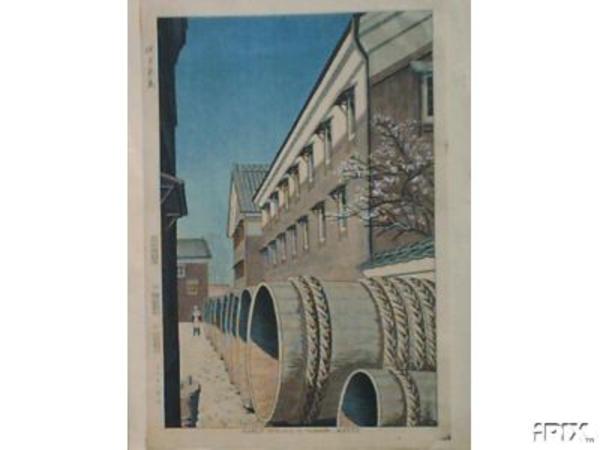
Fushimi Inari Temple
伏見稲荷
Woodblock print

The Compound of the Tenman Shrine at Kameido in the Snow (Kameido Tenmangu keidai no yuki), from the series "Famous Places in the Eastern Capital (Toto meisho)"
c. 1832/38
Color woodblock print; oban
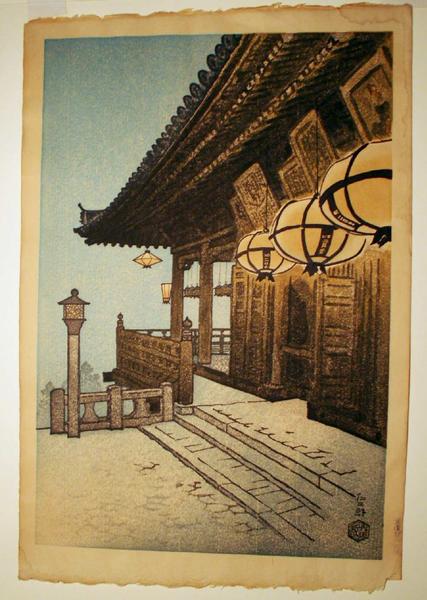
Temple with lanterns
Woodblock print

A Section of the Byodo Temple at Uji (Uji Byodoin no ichibu), from the series "Souvenirs of Travel, Second Series (Tabi miyage dai nishu)"
Uji Byodoin no ichibu
1921
Color woodblock print; oban
Featured in Collections
Curated cross-cuts that include this print.
Frequently Asked Questions
Confucius Temple in Nagasaki was created by Jun'ichiro Sekino (関野準一郎).
Confucius Temple in Nagasaki depicts temples & shrines.