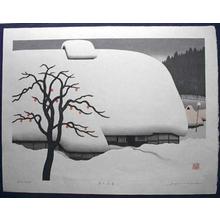
Winter in Yamazato — Fuyu no Yamazato
- Medium:
- Woodblock print
- Source:
- Japanese Art Open Database
- Image courtesy of
- Japanese Art Open Database
Description
Yamazato (山里) translates as mountain village, an evocative term in classical Japanese poetry (waka) describing remote rural settlements at elevation. The fuyu no yamazato—winter mountain village—is a canonical subject in Japanese visual and literary culture, appearing in seasonal verse collections and painting long before printmaking. Sekino's approach brings sosaku-hanga's directness to this traditional subject: unprinted washi stands for snow blanketing rooftops and ground, while graduated blue-gray tones describe sky and the deep shadows of snow accumulation under eaves. Traditional wooden farmhouses, a shrine building, or a stone wall disappearing under drifts likely anchor the composition. The cold stillness of a remote village in winter—the quality that waka poets called fuyu no sabishisa (winter loneliness)—would be conveyed not through sentiment but through restrained palette and the weight of white space.
More Prints by Jun'ichiro Sekino


More Snow Scenes Prints
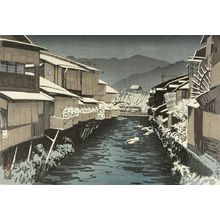
Fair Weather After Snow at Yamato Bridge, Kyoto (Yamato bashi no yukibare), Taishô period, dated 1924
Woodblock print

The Compound of the Tenman Shrine at Kameido in the Snow (Kameido Tenmangu keidai no yuki), from the series "Famous Places in the Eastern Capital (Toto meisho)"
c. 1832/38
Color woodblock print; oban

Miyajima in Snow (Yuki no Miyajima)
Yuki no Miyajima
1929
Color woodblock print; oban
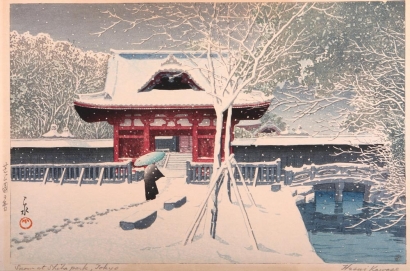
Evening Snow at Shiha Park, Tokyo
1932
Woodblock print
Featured in Collections
Curated cross-cuts that include this print.
Frequently Asked Questions
Winter in Yamazato — Fuyu no Yamazato was created by Jun'ichiro Sekino (関野準一郎).
Winter in Yamazato — Fuyu no Yamazato depicts snow scenes.