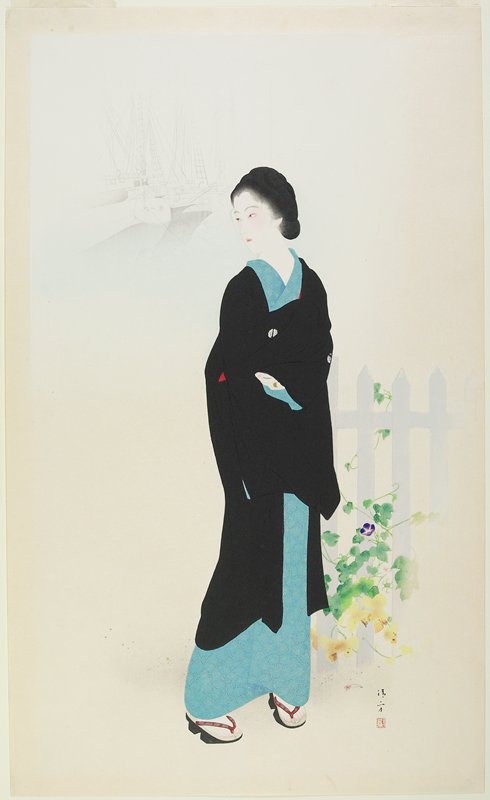
Akashi-chō in Tsukiji
- Date:
- 1931
- Medium:
- Woodblock print, ink and color on paper
- Format:
- Oban
- Dimensions:
- 61 × 36.8 cm
- Publisher:
- Watanabe Shozaburo
- Source:
- Minneapolis Institute of Art
Description
Dated 1931, this woodblock print in ink and color on paper depicts Akashi-cho, a street in the Tsukiji district of Tokyo that was part of the former foreign settlement established in the early Meiji period. The neighborhood's Western-style architecture and cosmopolitan atmosphere made it a distinctive corner of the capital, and Kaburaki Kiyokata, who grew up in nearby Kanda, knew these streets intimately. His 1931 rendering captures Tsukiji during a period when the district still retained traces of its international past while integrating into the broader fabric of modern Tokyo. The oban format gives the composition adequate scale to convey both architectural detail and the street-level atmosphere of pedestrians, signage, and the subtle indicators of neighborhood character that a close observer notices.
More Prints by Kaburaki Kiyokata


More Urban Scenes Prints
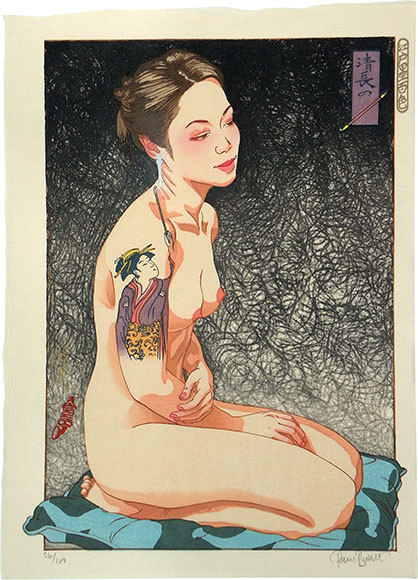
A Hundred Shades of Ink of Edo: Kiyonaga's Pipe (Edo zumi hyaku shoku: Kiyonaga no kiseru)
Woodblock print

View of Kabuki Theater from Matsuya (Ginza Matsuya yori Kabukiza), no. 3 from the series "Pictures of Ginza, First Series (Gashu Ginza dai isshu)"
1928
Color lithograph

Distant View of Mitsukoshi Movie Theater in Shinjuku from the Sixth Floor of Hoteiya (Hoteiya rokkai kara Shinjuku Mitsukoshi Musashi no kan enbo zu), no. 1 from the series "Scenery of Shinjuku (Gashu Shinjuku fukei)"
1930
Color lithograph
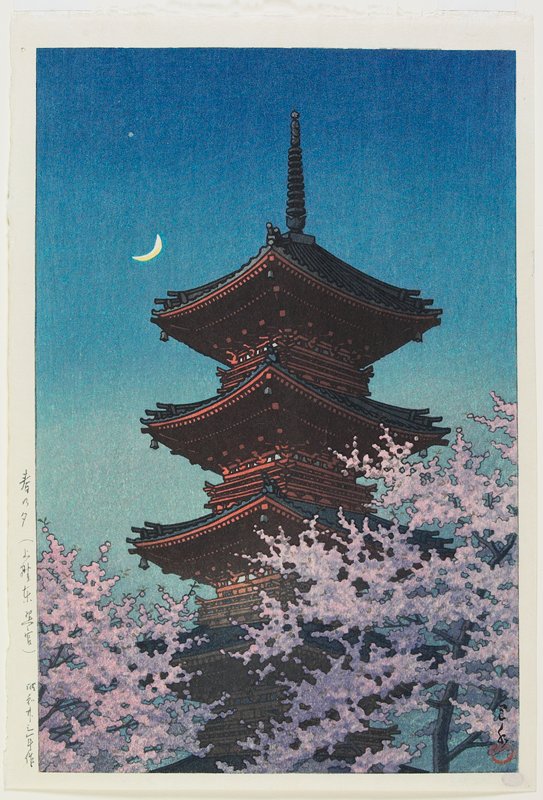
Spring Dusk at the Tōshō Shrine in Ueno
1948
Woodblock print, ink and color on paper
Featured in Collections
Curated cross-cuts that include this print.
Frequently Asked Questions
Akashi-chō in Tsukiji was created by Kaburaki Kiyokata (鏑木清方) in 1931.
Akashi-chō in Tsukiji was published by Watanabe Shozaburo (1931).
Akashi-chō in Tsukiji depicts urban scenes.
Akashi-chō in Tsukiji measures 61 × 36.8 cm (Oban format).