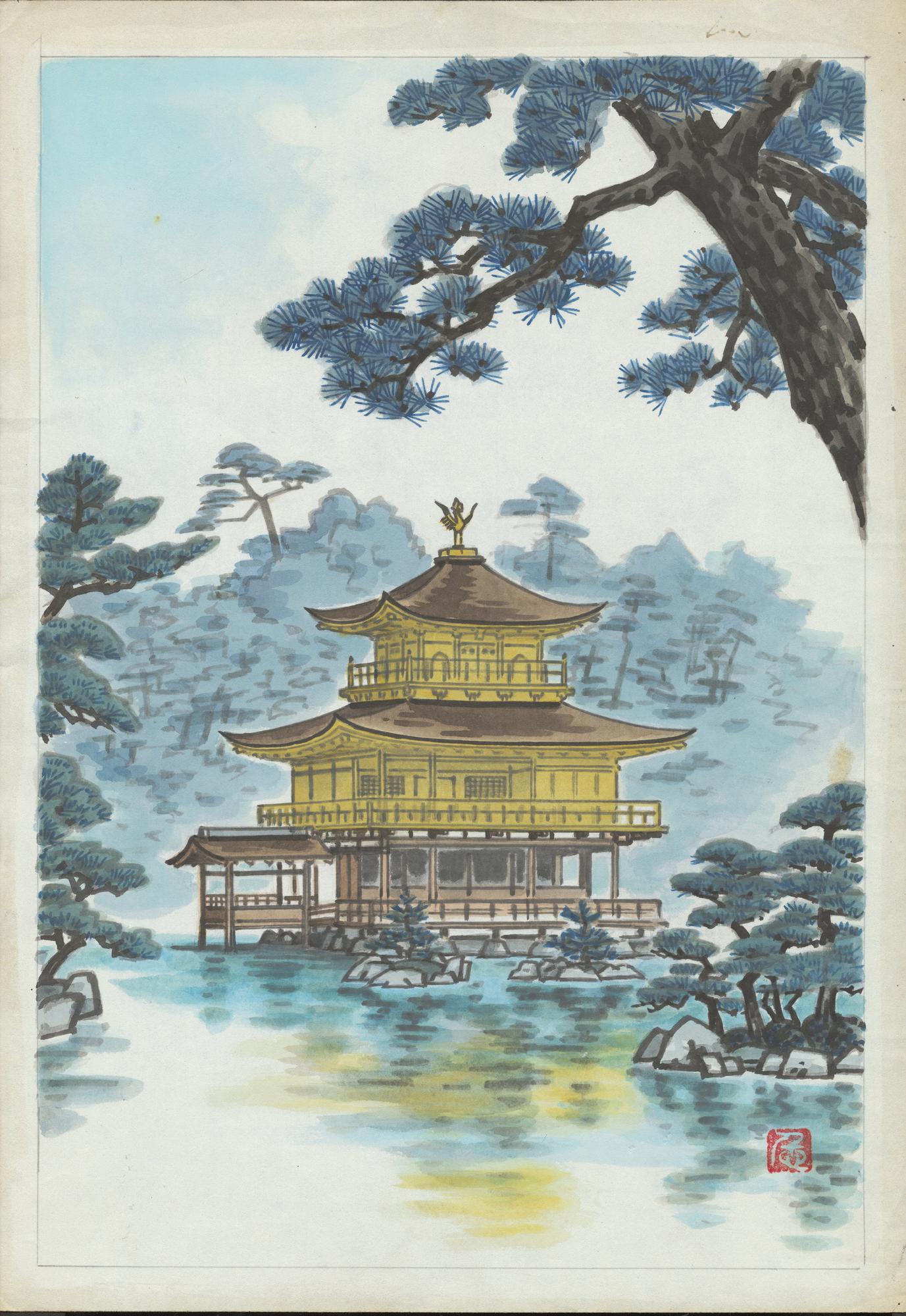
Kinkakuji Temple - 金閣寺 (1)
by Kamei Tobei
- Medium:
- Woodblock print
- Source:
- Ohmi Gallery
- Image courtesy of
- Ohmi Gallery
Description
Kinkakuji — the Temple of the Golden Pavilion — is among the most frequently depicted architectural subjects in Japanese landscape printmaking. The three-story pavilion constructed in 1397 for the Ashikaga shogun Yoshimitsu is covered in gold leaf on its upper floors and set over a reflective pond, providing natural conditions for the mirror-image compositions common in shin-hanga landscape. Kamei's treatment, numbered within a series, likely shows the pavilion from across Kyoko-chi (Mirror Pond), with the gold-leafed structure reflected in still water. The seasonal setting — spring cherry blossom, summer foliage, autumn color, or winter snow — would determine the color palette and atmospheric qualities of the print. The relationship between the architectural form and its water reflection was a compositional formula that allowed artists to explore symmetry and distortion within a single image.
More Prints by Kamei Tobei
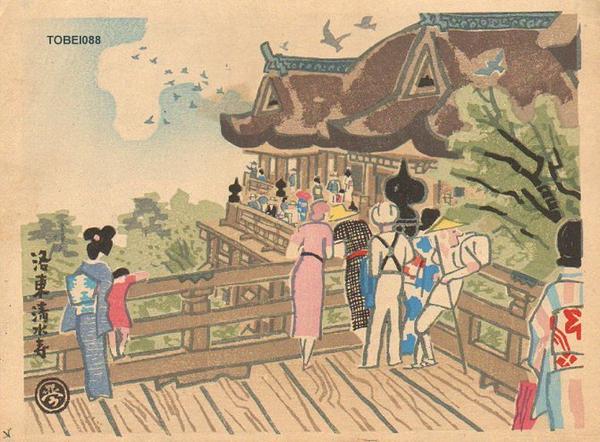


More Temples & Shrines Prints
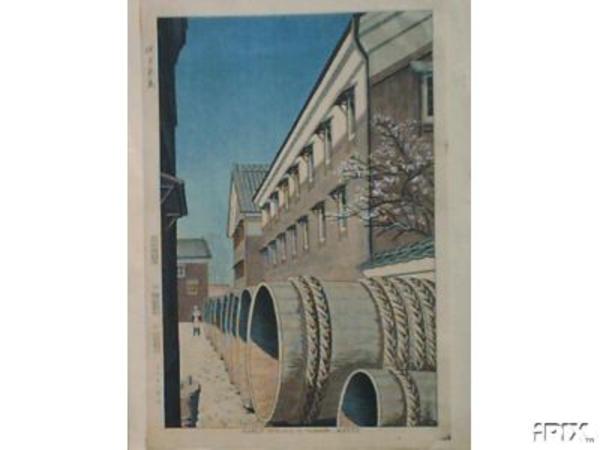
Fushimi Inari Temple
伏見稲荷
Woodblock print

The Compound of the Tenman Shrine at Kameido in the Snow (Kameido Tenmangu keidai no yuki), from the series "Famous Places in the Eastern Capital (Toto meisho)"
c. 1832/38
Color woodblock print; oban
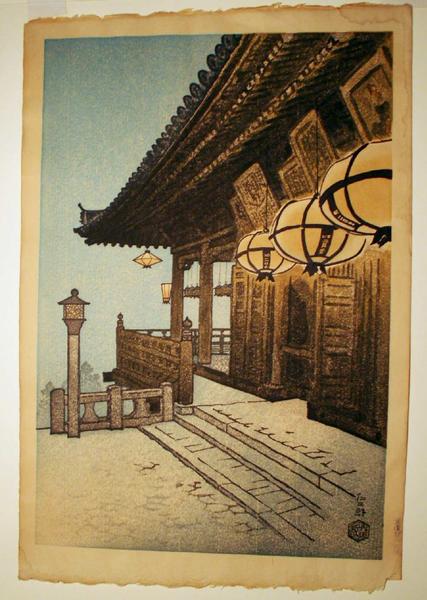
Temple with lanterns
Woodblock print

A Section of the Byodo Temple at Uji (Uji Byodoin no ichibu), from the series "Souvenirs of Travel, Second Series (Tabi miyage dai nishu)"
Uji Byodoin no ichibu
1921
Color woodblock print; oban
Featured in Collections
Curated cross-cuts that include this print.
Frequently Asked Questions
Kinkakuji Temple - 金閣寺 (1) was created by Kamei Tobei (亀井東平).
Kinkakuji Temple - 金閣寺 (1) depicts temples & shrines.