
the river Uji at moonrise in Kyoto
by Kamei Tobei
- Medium:
- Woodblock print
- Format:
- Oban
- Source:
- Japanese Art Open Database
Description
A wide river winds toward a pale yellow full moon low on the horizon, its light laid down the water's center in a vertical band of gold against the blue-grey current. Rounded hills in blue-grey wash frame the far bank, with a cluster of rooftops on the right shore and dark, slender trees lining both banks; two women in kimono (one blue, one red) stand at a wooden railing on a bridge or platform in the foreground, looking out over the water. A red seal and vertical Japanese characters appear in the lower right corner of the print.
More Prints by Kamei Tobei


More Landscapes Prints

Lake Kugushi in Wakasa Province (Wakasa Kugushiko), from the series Souvenirs of Travel I (Tabi miyage dai isshu)"
Wakasa Kugushiko
1920
Color woodblock print; oban
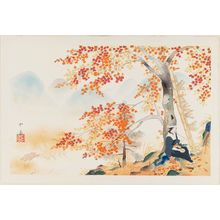
Autumn Maple Leaves at Takao, from the album Eight Views of Kyoto (Kyôto hakkei)
Woodblock print

The Beach at Kaiganji in Sanuki Province (Sanuki Kaiganji no hama), from the series "Collection of Views of Japan II, Kansai Edition (Nihon fukei shu II Kansai hen)"
1934
Color woodblock print; oban

Tea Kettle, section of a sheet from the series "Mirror of Stone Rubbings of Views of the Provinces" (Kohon meihitsu ishizuri kagami)
n.d.
Woodblock print; ishizuri-e, section of harimaze sheet
Featured in Collections
Curated cross-cuts that include this print.
Frequently Asked Questions
the river Uji at moonrise in Kyoto was created by Kamei Tobei (亀井東平).
the river Uji at moonrise in Kyoto depicts landscapes and rivers & lakes, set at Kyoto.