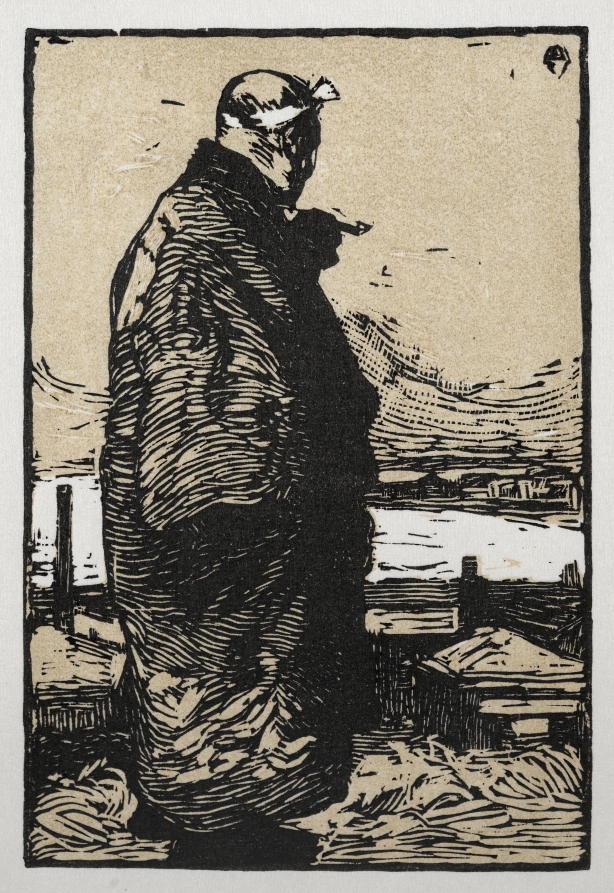
Fisherman
- Date:
- 1906
- Medium:
- woodcut
- Edition:
- Self-printed
- Source:
- Cleveland Museum of Art
Description
This 1906 woodcut is the work that launched the sosaku-hanga movement. Depicting a solitary fisherman hauling his catch, the print was revolutionary not for its subject but for its method: Yamamoto designed, carved, and printed it entirely himself, rejecting the traditional division of labor between designer, carver, and printer that had defined Japanese printmaking for centuries. The bold, rough-hewn lines show the direct influence of European woodcut traditions, particularly the expressive carving of artists like Edvard Munch. Published in the literary magazine Myojo, the Fisherman print announced that woodblock printing could be a medium for individual artistic expression. Its historical significance far exceeds its modest scale, marking the moment when Japanese printmaking split into two competing philosophies.
More Prints by Kanae Yamamoto

More Figures Prints
Featured in Collections
Curated cross-cuts that include this print.
Frequently Asked Questions
Fisherman was created by Kanae Yamamoto (山本鼎) in 1906.
Fisherman depicts figures and animals.