
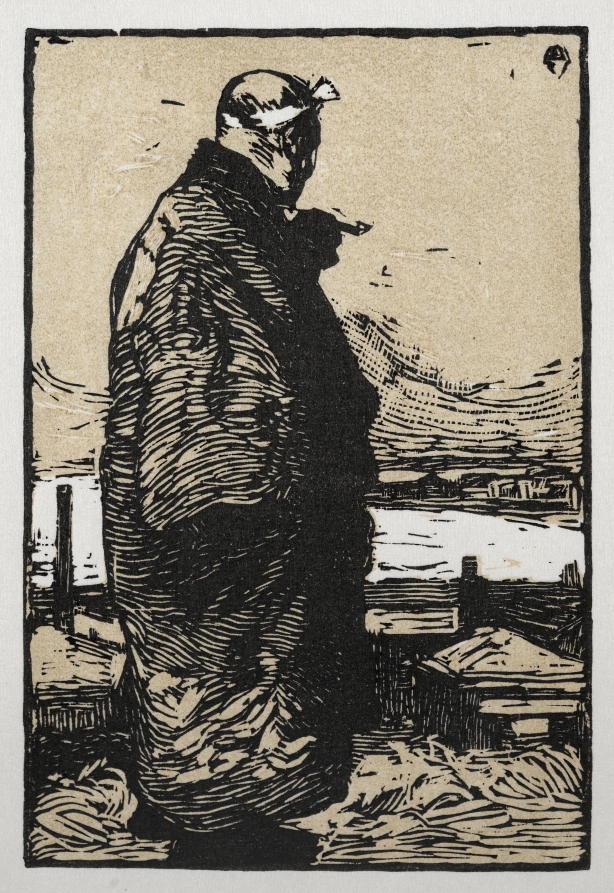
Fisherman
- Medium:
- Mokuhanga (Japanese woodblock)
- Image courtesy of
- Saru Gallery
Description
Fisherman stands at the origin point of the sosaku-hanga (creative prints) movement, and Yamamoto's principle that one artist should design, carve, and print a single work — jiga-jikoku-jizuri — flowed directly from this 1904 sheet. Where the parallel shin-hanga movement that emerged a decade later under Watanabe Shozaburo retained the four-handed ukiyo-e workshop system of designer, carver, printer, and publisher, sosaku-hanga insisted on unified authorship, and Fisherman became its founding example. The image depicts a working fisherman treated not as a picturesque type from a meisho-e travel series but as an individual subject in the manner of European peasant portraiture — Yamamoto had been studying reproductions of Millet, Vallotton, and Munch through the journal Myojo, where this print was first published. Later sosaku-hanga artists including Onchi Koshiro, Hiratsuka Un'ichi, and Maekawa Sempan would build on the framework Yamamoto established here. The print's continued reproduction across multiple impressions reflects its status as the movement's symbolic starting point rather than as a single rare object circulating among collectors.
More Prints by Kanae Yamamoto

Featured in Collections
Curated cross-cuts that include this print.
Frequently Asked Questions
Fisherman was created by Kanae Yamamoto (山本鼎).