
Kintai bridge
by Saito Kaoru
- Medium:
- Etching
- Image courtesy of
- Saru Gallery
Description
The Kintai Bridge spans the Nishiki River at Iwakuni in Yamaguchi Prefecture, its five wooden arches first constructed in 1673 and repeatedly rebuilt to the original design after floods and wartime destruction. Saito's etched treatment of the subject departs from the literary interiors of his Genji series, placing him within the meisho-e tradition of celebrated-place imagery that runs through earlier ukiyo-e from Hokusai's Shokoku meikyō kiran onward. An etched composition would emphasize the rhythmic geometry of the arches, the stone piers, and the river surface beneath, working in incised line and aquatint rather than the saturated tonal fields of his mezzotint plates. The repeated curves lend themselves to the formal discipline of the etched line, where each arc can be built up through controlled cross-hatching and successive bites of acid. The subject reflects Saito's range beyond the literary cycle for which he is principally remembered, extending his catalog into Japan's continuing dialogue with its architectural landmarks.
More Prints by Saito Kaoru



More Bridges Prints
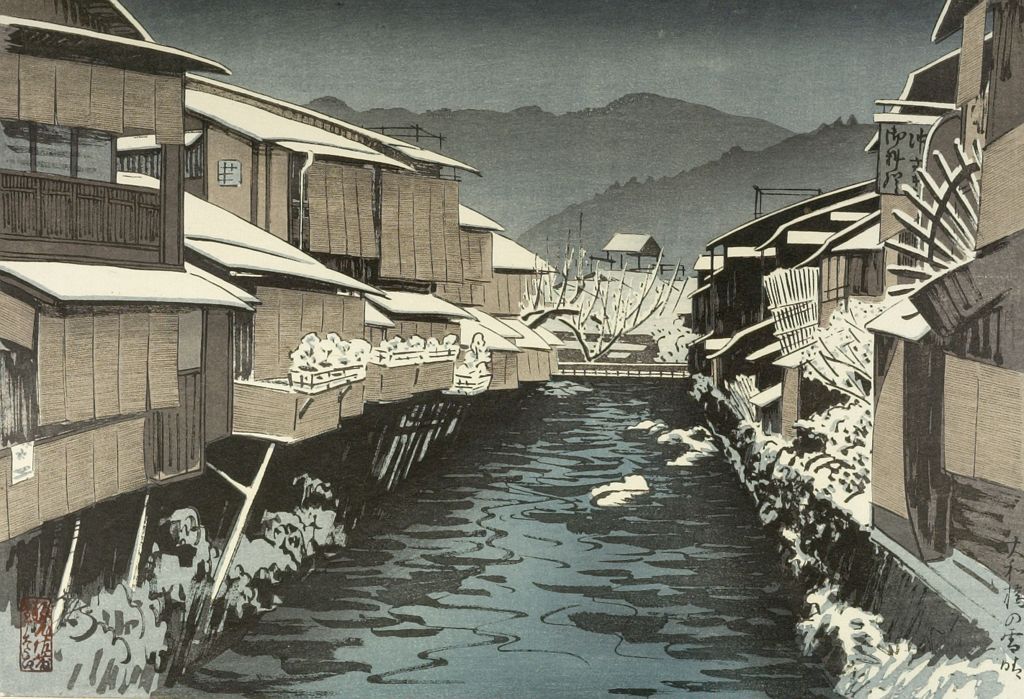
Fair Weather After Snow at Yamato Bridge, Kyoto (Yamato bashi no yukibare), Taishô period, dated 1924
Woodblock print
![Mount Fuji on a Moonlit Night, Kawai Bridge (Tsukiyo no Fuji [Kawaibashi]), from the series "Selection of Views of the Tokaido (Tokaido fukei senshu)" by Kawase Hasui](https://www.artic.edu/iiif/2/d0960668-1e73-339a-b182-fb995a54bff0/full/843,/0/default.jpg)
Mount Fuji on a Moonlit Night, Kawai Bridge (Tsukiyo no Fuji [Kawaibashi]), from the series "Selection of Views of the Tokaido (Tokaido fukei senshu)"
1947
Color woodblock print; oban

Shin Ohashi Bridge (Shin Ohashi), from the series "Twenty View of Tokyo (Tokyu nijukkei)"
1926
Color woodblock print; oban

Sacred Bridge in Nikko (Nikko Shinkyo)
1930
Color woodblock print; oban
Featured in Collections
Curated cross-cuts that include this print.
Frequently Asked Questions
Kintai bridge was created by Saito Kaoru (斎藤薫).
Kintai bridge depicts bridges.