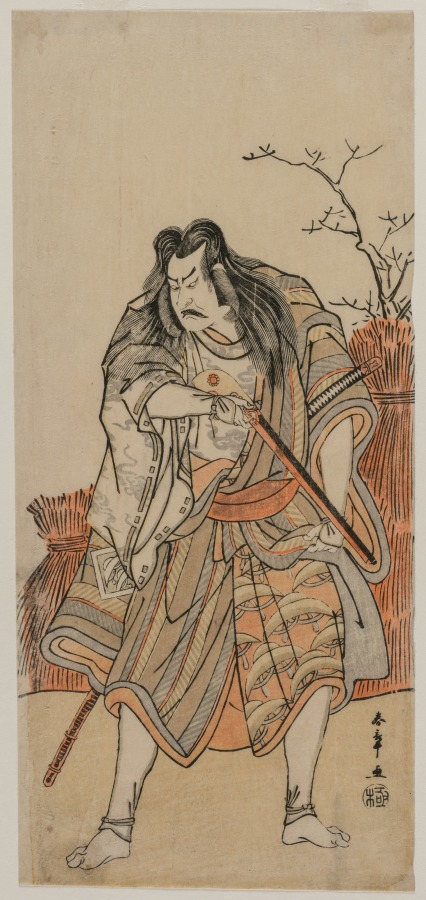
Man Falling Backward, Startled by a Woman's Ghost over a River
- Date:
- c. 1782
- Medium:
- Color woodblock print; hosoban diptych
- Source:
- Art Institute of Chicago
Description
This Katsukawa Shunsho design, held by the Art Institute of Chicago and produced around 1777, depicts a man recoiling in terror as a woman's ghost materializes above a river. Although Shunsho is best known as the founder of the Katsukawa school of Edo ukiyo-e and as the leading designer of yakusha-e actor prints, his oeuvre encompassed narrative subjects drawn from the supernatural traditions of Japanese folklore, kabuki, and noh drama. The composition exploits the vertical format to suspend the spectral figure above the water while the male figure tumbles backward in the lower register, the dramatic diagonal generating the moment of revelation that defined the kaidan, or ghost-story, genre then circulating widely in Edo popular literature and theater. Shunsho's draftsmanship handles the contrasting figures with characteristic restraint, the ghost rendered in pale, attenuated line to suggest transparency and the falling man given the physical weight that emphasizes the apparition's uncanny presence. Such subjects were closely tied to summer-season kabuki, when ghost plays drew large audiences seeking cooling thrills, and the print likely circulated in concert with one of the period's stage productions. The Art Institute of Chicago preserves the sheet as evidence of the Katsukawa school's range beyond pure actor portraiture, demonstrating how Shunsho engaged with the supernatural narrative tradition that shaped much of the era's popular visual culture.