The Earth Spider Slain by Brave Samurai Watanabe no Tauna (center image)
- Date:
- about 1800-1810
- Medium:
- Color woodblock print
- Source:
- Art Institute of Chicago
Description
Dated about 1800–1810 and held by the Art Institute of Chicago (accession 1990.607.406), this Katsukawa Shuntei woodblock print is the center sheet of a triptych depicting one of the most famous episodes of Japanese warrior legend: the slaying of the giant earth-spider (tsuchigumo) by Watanabe no Tsuna (sometimes transliterated Tauna in older catalogs). Watanabe no Tsuna (953–1025) was a Heian-period warrior and the chief retainer of Minamoto no Yorimitsu (Raikō), and together with Yorimitsu's other three retainers — the so-called Four Heavenly Kings of Yorimitsu — he became the subject of an extensive cycle of medieval warrior legends. The tsuchigumo, a monstrous earth-spider with supernatural powers, was one of the recurring antagonists of these tales, attacking Yorimitsu and his retainers and ultimately being slain after a heroic battle. The story had been a fixture of Japanese pictorial tradition since the medieval Tsuchigumo emaki (Earth Spider scroll) of the late thirteenth or fourteenth century, and Edo-period woodblock-print designers returned to it repeatedly as one of the canonical subjects for warrior imagery. Shuntei's triptych composition typifies the late-Katsukawa school approach to musha-e (warrior prints) in the early nineteenth century: a multi-sheet dramatic action scene, executed in the bold compositional manner that the school had developed since the 1790s, with mythological monster and armored samurai providing the focal contrast. This print and others like it position Shuntei as an important precursor to the great heroic-warrior series of Utagawa Kuniyoshi in the 1820s and 1830s, which would extend and transform the Katsukawa-school musha-e tradition for a new generation of Edo viewers.
More Prints by Katsukawa Shuntei

No. 3: Kato Kiyomasa, from the series "Three Tales of Valor (Buyu sanban tsuzuki)"
1820
Color woodblock print; shikishiban, surimono

A Woman as Ebisu, from the series "Seven Women as the Gods of Good Fortune for the Hanagasa Poetry Club (Hanagasaren shichifukujin)"
c. 1820
Color woodblock print; shikishiban, surimono

Chohi (Zhang Fei) on Black Horse
1810s
Color woodblock print
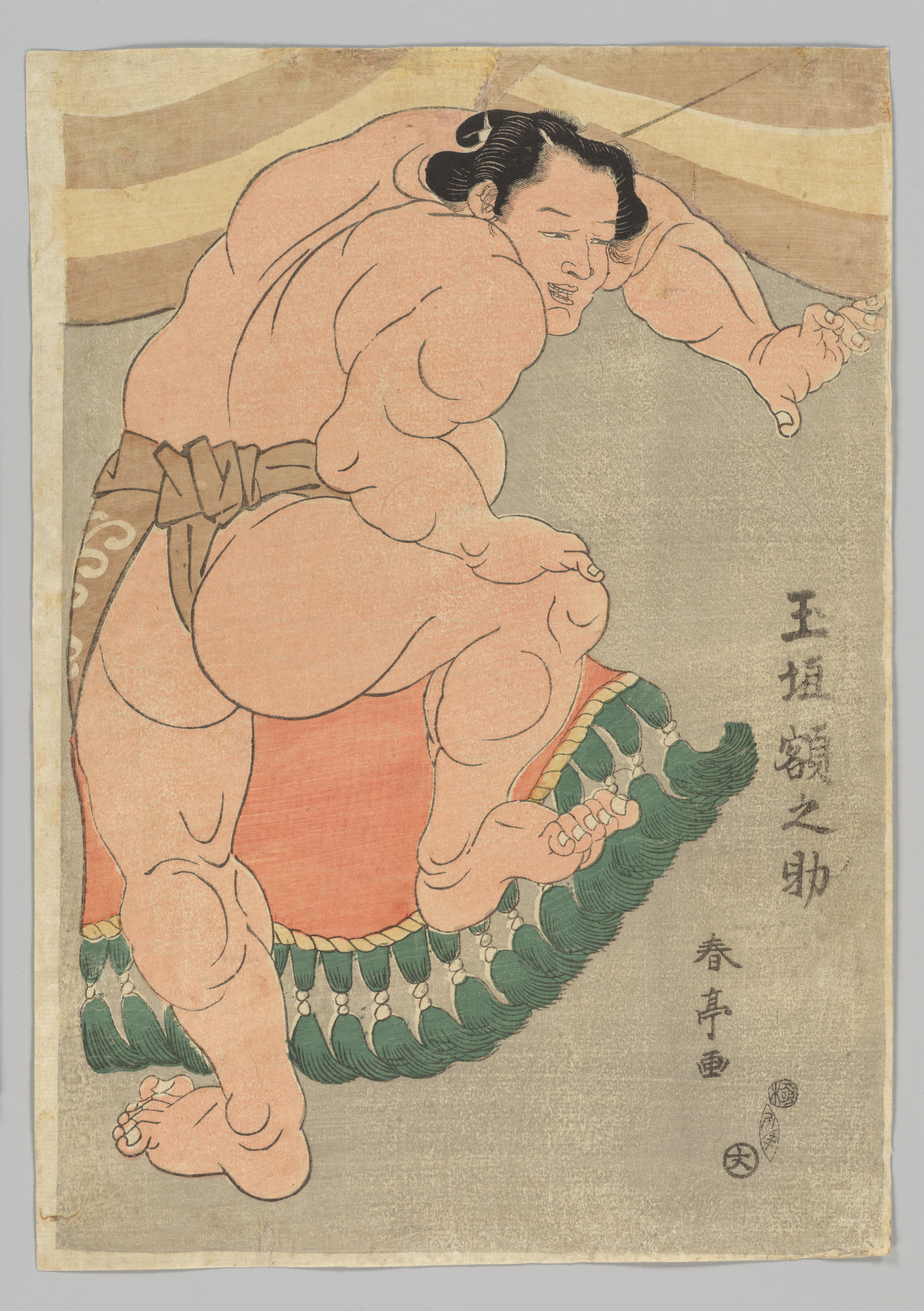
Sumo Wrestler Tamagaki Gakunosuke IV
1811-14 (possibly ca. 1813)
Wood-block print (nishiki-e); ink and color on paper
Frequently Asked Questions
The Earth Spider Slain by Brave Samurai Watanabe no Tauna (center image) was created by Katsukawa Shuntei (勝川春亭) in about 1800-1810.