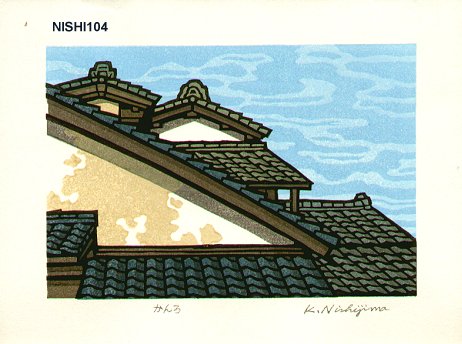
KANRO (late autumn to early winter)
- Medium:
- Woodblock print
- Source:
- Watanabe Print
- Image courtesy of
- Watanabe Print
Description
A close-up view of overlapping tiled rooftops with dark blue-grey shingles and ornate curved ridge caps, set against a mottled sky rendered in bands of blue and white. Warm tan-gold tones on the gable end contrast with the cool blues of the roof tiles and sky, giving the composition a quiet, graphic simplicity. Woodblock print titled "Kanro (late autumn to early winter)" by Katsuyuki Nishijima.
More Prints by Katsuyuki Nishijima

More Snow Scenes Prints
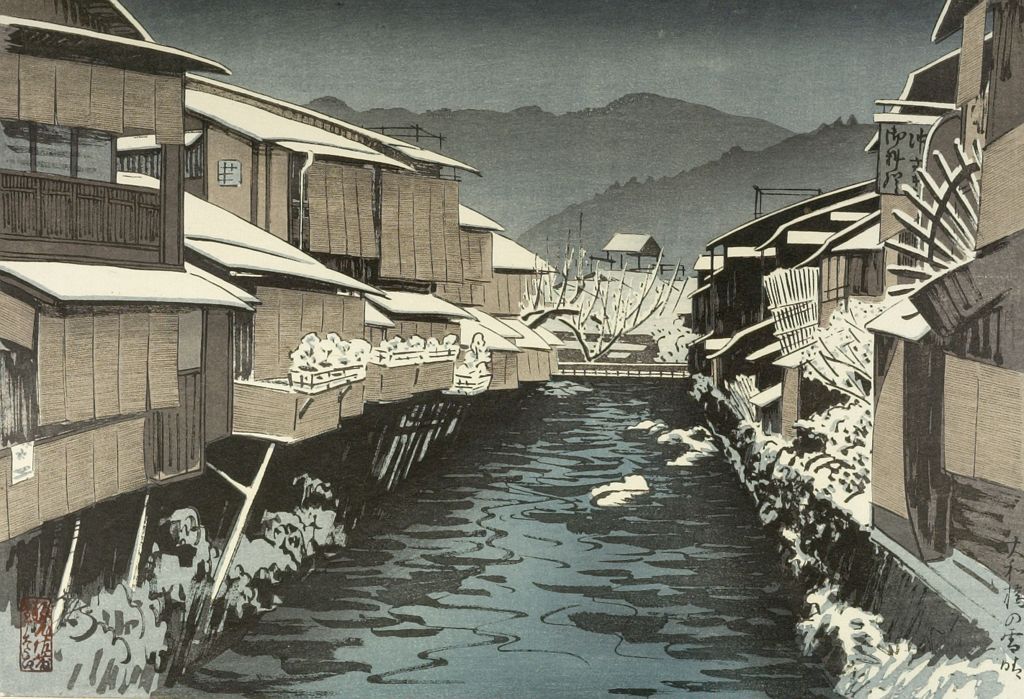
Fair Weather After Snow at Yamato Bridge, Kyoto (Yamato bashi no yukibare), Taishô period, dated 1924
Woodblock print

The Compound of the Tenman Shrine at Kameido in the Snow (Kameido Tenmangu keidai no yuki), from the series "Famous Places in the Eastern Capital (Toto meisho)"
c. 1832/38
Color woodblock print; oban

Miyajima in Snow (Yuki no Miyajima)
Yuki no Miyajima
1929
Color woodblock print; oban
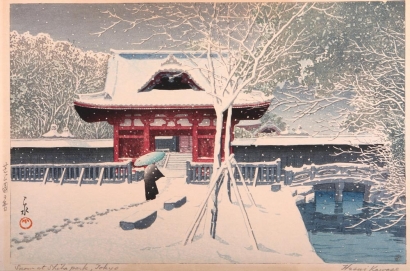
Evening Snow at Shiha Park, Tokyo
1932
Woodblock print
Frequently Asked Questions
KANRO (late autumn to early winter) was created by Katsuyuki Nishijima (西島勝之).
KANRO (late autumn to early winter) depicts snow scenes.