Rain scenes are Hasui's second most desirable atmospheric category, carrying a 20–40% premium over comparable clear-weather subjects. Rainy Season, Shinagawa (1931) sold for $4,375 at Christie's Online (2020). The bokashi gradation technique used for rain effects demands superior impressions — well-preserved sky gradations add significantly to value, while faded examples lose much of their impact. Pre-war lifetime editions bearing the Watanabe copyright seal (A through G types, 1926–1944) are the most desirable.
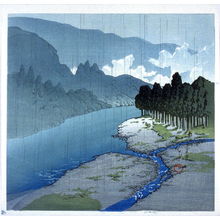
Early Summer Rain at Arakawa, published in June 1932, shows the Arakawa River in northern Tokyo under the persistent gray drizzle of early summer — the samidare season of steady, mist-softened rain that characterizes early June before the tsuyu rainy season properly begins. The Arakawa, a wide managed watercourse running through the flat lowlands of northern Tokyo, offered Hasui broad, atmospheric vistas where rain and river merged into a single gray-green expanse. The June publication date aligns with the subject's meteorological specificity, as Hasui frequently matched publishing season to depicted weather.

1962
Woodblock print, ink and color on paper

c. 1833-36
Woodblock print (nishiki-e); ink and color on paper

Ame no Omiya
1930
Color woodblock print; oban

Teradomari no yau
1921
Color woodblock print; oban
Curated cross-cuts that include this print.
Early Summer Rain, Arakawa (Samidare (Arakawa)) (Samidare (Arakawa) was created by Kawase Hasui (川瀬巴水) in June 1932.
Early Summer Rain, Arakawa (Samidare (Arakawa)) uses Bokashi, Nishiki-e, and Moku-hanga, on color woodblock print.
Early Summer Rain, Arakawa (Samidare (Arakawa)) was published by Watanabe Shozaburo (June 1932).
Early Summer Rain, Arakawa (Samidare (Arakawa)) depicts rain and summer.
Early Summer Rain, Arakawa (Samidare (Arakawa)) measures 23.8 × 36.2 cm (Oban format).