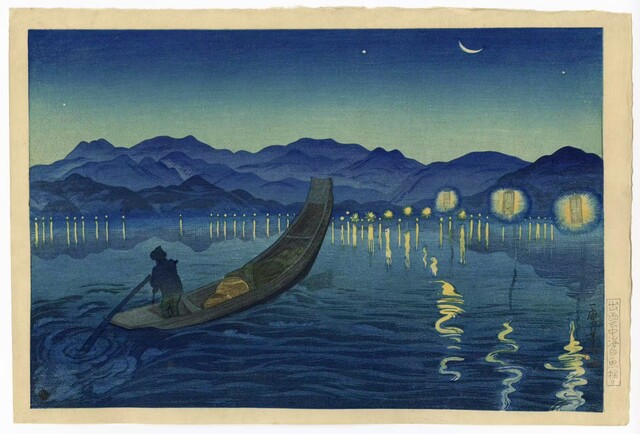
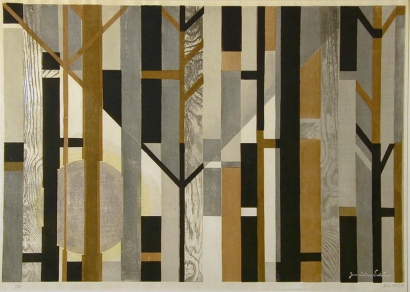
Catching Whitebait at Nakaumi (出雲中海白魚採り)
by Oda Kazuma
- Date:
- 1925
- Medium:
- Woodblock Print
- Image courtesy of
- Artsy
Description
Catching Whitebait at Nakaumi, dated 1925, with the Japanese title Izumo Nakaumi Shirauo Tori, presents a working scene on the inland lagoon of Nakaumi between Matsue and Sakaiminato on the San'in coast of Izumo Province in modern Shimane Prefecture. The print is documented on Artsy at https://www.artsy.net/artwork/kazuma-oda-catching-whitebait-at-nakaumi-chu-yun-zhong-hai-bai-yu-cai-ri. Oda Kazuma (1882-1956) trained first under Yamamoto Hosui in the Western-style yoga tradition and worked as a draftsman and lithographer at the Ministry of Finance Insatsu Kyoku printing bureau before turning to watercolor and then woodblock as his principal mediums. From the early 1910s onward he combined extensive watercolor sketching of regional Japan with prints that placed him at the intersection of shin-hanga and sosaku-hanga rather than at the center of either movement, and he was an active member of the Nihon Sosaku Hanga Kyokai founded in 1918 by Yamamoto Kanae, Minami Kunzo, and Tobari Kogan. Nakaumi's whitebait fishery was a recognized seasonal activity, and Oda's interest in such labor scenes places his work alongside the better-known landscape projects of the period as a quieter, ethnographic record of provincial working life rather than the picturesque meisho of Kawase Hasui or the alpine sublime of Yoshida Hiroshi. The 1925 dating coincides with Oda's productive mid-career, during which he favored a quiet, gradient-rich color sense in which the bokashi gradation of the woodblock medium does the work of weather, hour, and atmosphere across broad water and low coastal sky. His landscape and labor prints of the period are best read as a self-carved or closely supervised counterpart to the Watanabe Shozaburo shin-hanga of his contemporaries, focused not on iconic meisho but on the less storied regional places of working Japan. The San'in cycle into which this Nakaumi sheet falls includes several Izumo-region subjects from 1925 and stands among the strongest documentary projects in his career. Comparable Oda prints are preserved at the Tokyo National Museum, the Kobe City Museum, the British Museum, the Honolulu Museum of Art, and the Library of Congress.
More Prints by Oda Kazuma

More Nature Prints



Featured in Collections
Curated cross-cuts that include this print.
Frequently Asked Questions
Catching Whitebait at Nakaumi (出雲中海白魚採り) was created by Oda Kazuma (織田一磨) in 1925.
Catching Whitebait at Nakaumi (出雲中海白魚採り) depicts nature and animals.