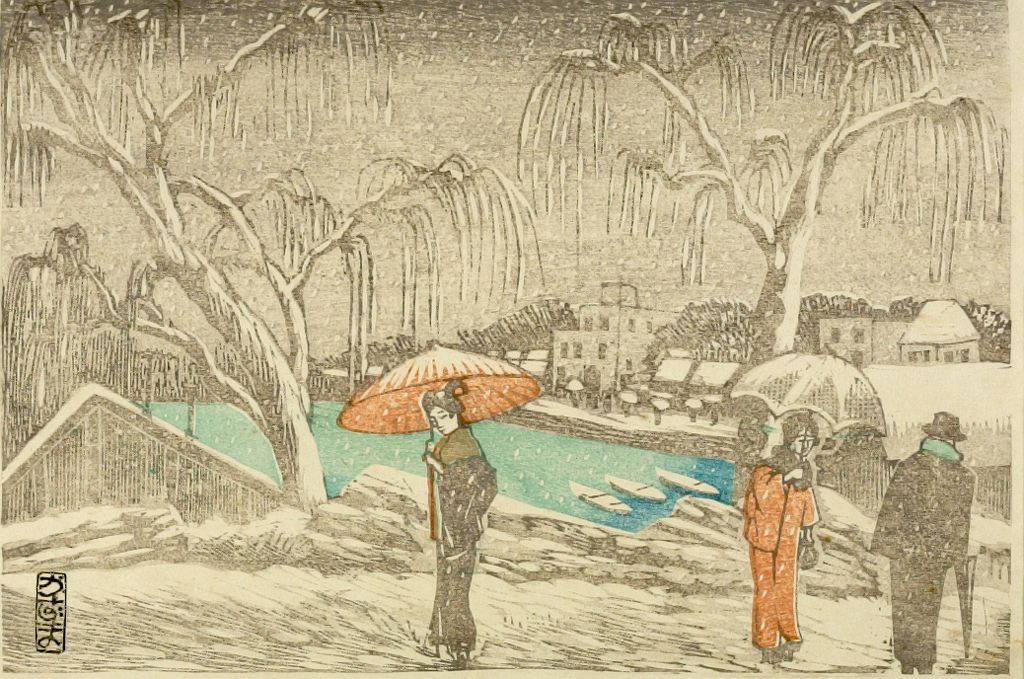
Sumida Park
by Oda Kazuma
- Medium:
- Mokuhanga (Japanese woodblock)
- Image courtesy of
- Saru Gallery
Description
Sumida Park, laid out along both banks of the Sumida River as part of the post-1923 earthquake reconstruction, became a modern leisure ground celebrated for its cherry trees, descendants of the Edo-period plantings of Tokugawa Yoshimune. Oda's print likely shows the embankment with its railing, lamp posts, and silhouetted figures strolling beneath blossoms or bare branches, with the river broadening toward a distant span such as Azumabashi or Kototoibashi. [Bokashi](/glossary/bokashi) gradation in water and sky establishes atmospheric depth, while the keyblock describes trunks and lantern poles in flat graphic line. As a topographic subject, the park belongs to a modernized [meisho-e](/glossary/meisho-e) tradition: famous-place imagery refitted to depict Taishō and early-Shōwa public spaces. Oda's handling avoids the saccharine treatment of cherry-viewing common in tourist postcards, registering instead the spatial discipline of the new park—its straight paths, surveyed embankment, and engineered planting—that distinguished it from the unruly seasonal celebrations of pre-earthquake Mukōjima.

![[Garden of] Taj Mahal, No. 1 (Taji Maharu no niwa, dai ichi) by Hiroshi Yoshida](https://www.artic.edu/iiif/2/230993a7-d4f0-c979-c267-127d48e1ef1c/full/843,/0/default.jpg)