
Old pagoda
- Medium:
- Mokuhanga (Japanese woodblock)
- Image courtesy of
- Saru Gallery
Description
A second handling of the pagoda subject, distinct in composition or treatment from the related impression. Pagodas were a sustained preoccupation in Sasajima's work — he returned to the historic Buddhist sites of Nara and Kyoto across more than five decades, producing multiple impressions of the same structures from different vantages. The print likely emphasizes the stacked tiers and projecting eaves as a vertical rhythm of dark carved bands against reserved or tonally modulated washi. Bokashi may register the gradation of timber surfaces or the surrounding atmosphere. Sasajima's commitment to cutting and printing every block himself followed Onchi Koshiro's sosaku-hanga doctrine, which held that creative printmaking required unmediated contact between artist and material at every stage. Variants like this one suggest the artist working through the same architectural subject as a renewed compositional problem rather than a fixed image. The rough cherry-grain texture characteristic of his blocks would register in the printed surface as a counterpart to the actual weathering of the centuries-old pagoda timber.
More Prints by Kihei Sasajima


More Temples & Shrines Prints
Fushimi Inari Temple
伏見稲荷
Woodblock print

The Compound of the Tenman Shrine at Kameido in the Snow (Kameido Tenmangu keidai no yuki), from the series "Famous Places in the Eastern Capital (Toto meisho)"
c. 1832/38
Color woodblock print; oban
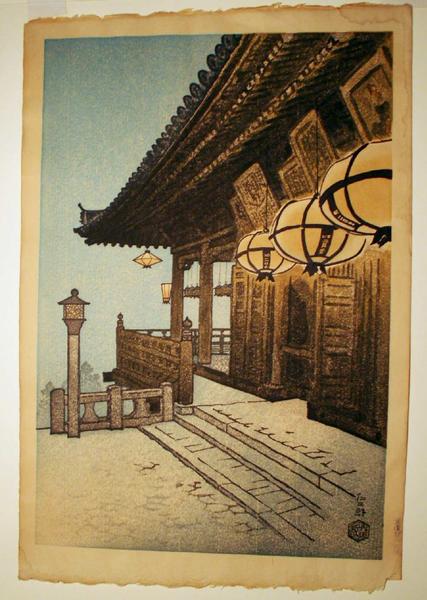
Temple with lanterns
Woodblock print

A Section of the Byodo Temple at Uji (Uji Byodoin no ichibu), from the series "Souvenirs of Travel, Second Series (Tabi miyage dai nishu)"
Uji Byodoin no ichibu
1921
Color woodblock print; oban
Featured in Collections
Curated cross-cuts that include this print.
Frequently Asked Questions
Old pagoda was created by Kihei Sasajima (笹島喜平).
Old pagoda depicts temples & shrines and pagodas.