
Pagoda
- Medium:
- Mokuhanga (Japanese woodblock)
- Image courtesy of
- Saru Gallery
Description
Pagoda enters Sasajima's central subject. Across more than five decades he returned to Buddhist architecture as his consuming theme, and the multi-storey pagoda -- with its repeated tiered roofs and stacked geometry -- offered him a natural carving problem. The image likely isolates the structure against open ground or sky, allowing the silhouette to be read in clean horizontal courses of curved roof eave above straight wall. Sasajima's gouge work tends toward direct, frontal description; bokashi gradations would be sparse. He preferred the graphic clarity of flat blocks pulled by his own hand to the atmospheric softening favoured by shin-hanga contemporaries. Carved-line work would emphasise the rhythm of timber bracketing, finial, and sloping eave. The print belongs to a sustained pagoda strand that ran across Sasajima's career, including studies of named pagodas at Horyu-ji, Yakushi-ji, and elsewhere. Every block was designed, carved, and printed by Sasajima alone, in the tradition of artist-as-complete-maker that Onchi Koshiro had defined for the sosaku-hanga movement.
More Prints by Kihei Sasajima


More Temples & Shrines Prints
Fushimi Inari Temple
伏見稲荷
Woodblock print

The Compound of the Tenman Shrine at Kameido in the Snow (Kameido Tenmangu keidai no yuki), from the series "Famous Places in the Eastern Capital (Toto meisho)"
c. 1832/38
Color woodblock print; oban
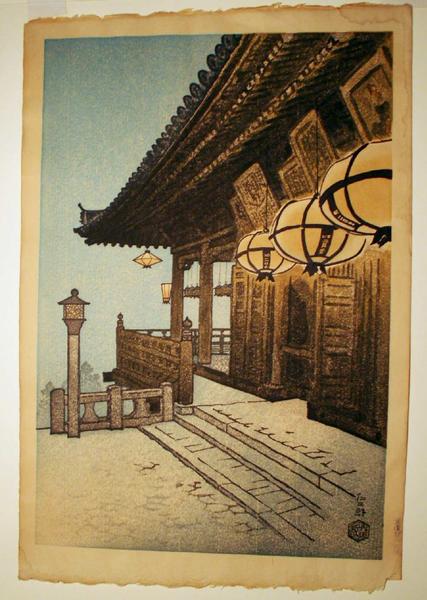
Temple with lanterns
Woodblock print

A Section of the Byodo Temple at Uji (Uji Byodoin no ichibu), from the series "Souvenirs of Travel, Second Series (Tabi miyage dai nishu)"
Uji Byodoin no ichibu
1921
Color woodblock print; oban
Featured in Collections
Curated cross-cuts that include this print.
Frequently Asked Questions
Pagoda was created by Kihei Sasajima (笹島喜平).
Pagoda depicts temples & shrines and pagodas.