
Pagoda In Nara
- Medium:
- Mokuhanga (Japanese woodblock)
- Image courtesy of
- Saru Gallery
Description
Pagoda in Nara most likely depicts one of the city's surviving ancient pagodas -- the five-storey at Kofuku-ji, the five-storey at Horyu-ji, or the three-storey at Yakushi-ji -- structures that anchor Sasajima's lifelong meditation on Japanese Buddhist architecture. The composition probably foregrounds the pagoda as a single isolated mass, its tiered roofs counted off in carved horizontal bands. Sasajima approached such buildings as carving problems first and pictorial subjects second: the timber bracketing under each eave, the rhythm of slope and overhang, the verticality of the central pillar all become matters for the gouge. Colour is typically restrained -- earthen ochres, sumi blacks, sometimes a single muted green for surrounding pine. The print belongs to a sustained thread in Sasajima's output, his pilgrimage through the temple complexes of Nara and Kyoto, where he travelled repeatedly to draw and study before returning to his blocks. Every print was hand-carved and hand-pulled, a fifty-year discipline inherited from his teacher Onchi Koshiro and the sosaku-hanga movement.
More Prints by Kihei Sasajima

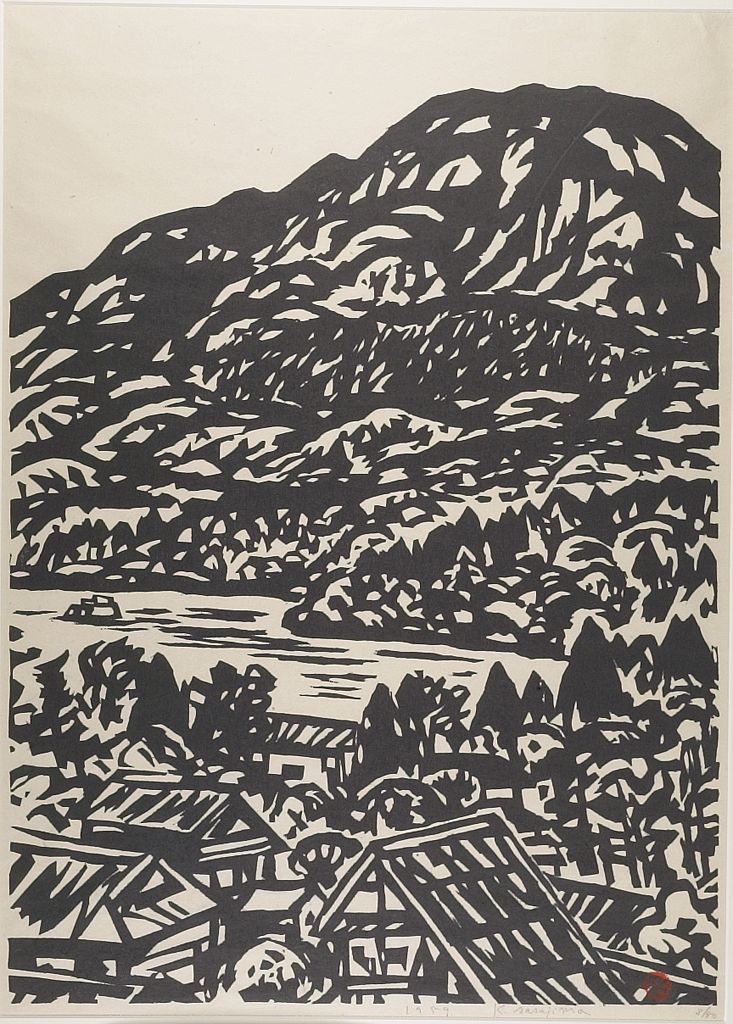
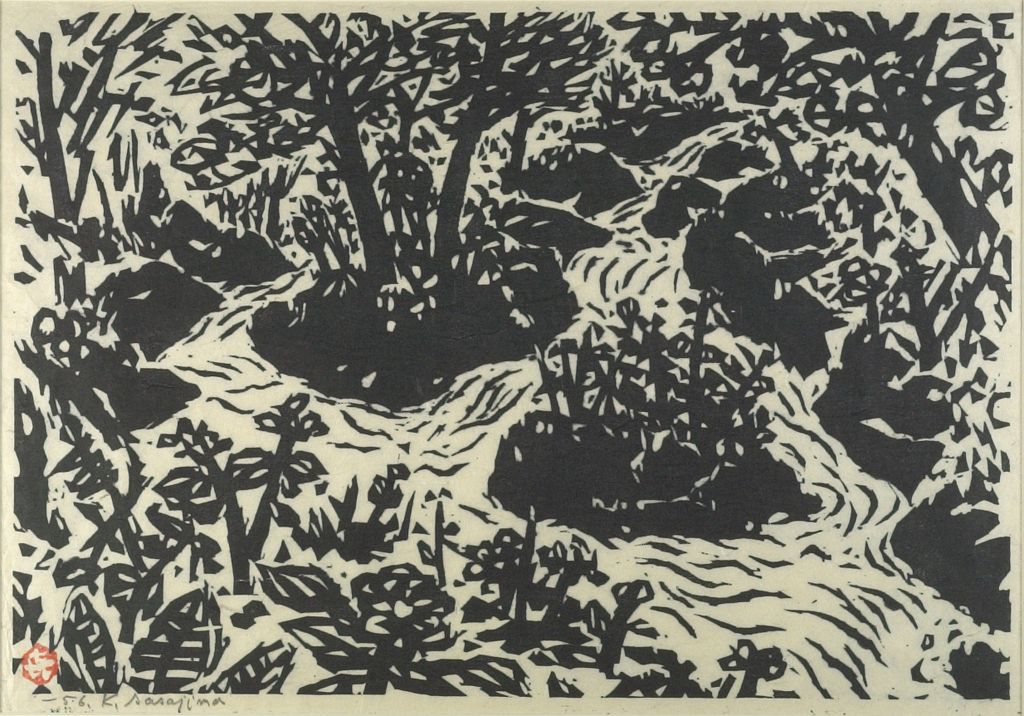

More Temples & Shrines Prints
Fushimi Inari Temple
伏見稲荷
Woodblock print

The Compound of the Tenman Shrine at Kameido in the Snow (Kameido Tenmangu keidai no yuki), from the series "Famous Places in the Eastern Capital (Toto meisho)"
c. 1832/38
Color woodblock print; oban
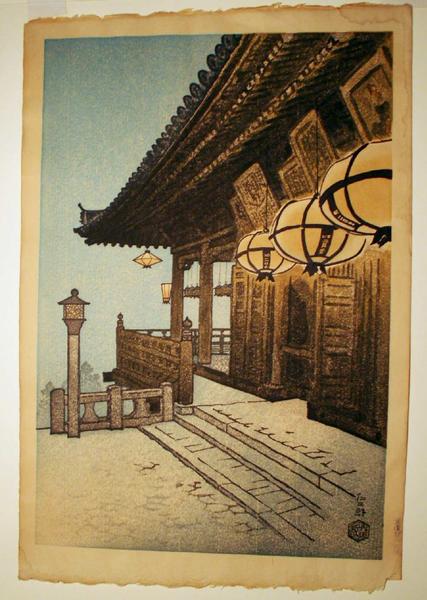
Temple with lanterns
Woodblock print

A Section of the Byodo Temple at Uji (Uji Byodoin no ichibu), from the series "Souvenirs of Travel, Second Series (Tabi miyage dai nishu)"
Uji Byodoin no ichibu
1921
Color woodblock print; oban
Featured in Collections
Curated cross-cuts that include this print.
Frequently Asked Questions
Pagoda In Nara was created by Kihei Sasajima (笹島喜平).
Pagoda In Nara depicts temples & shrines and pagodas.