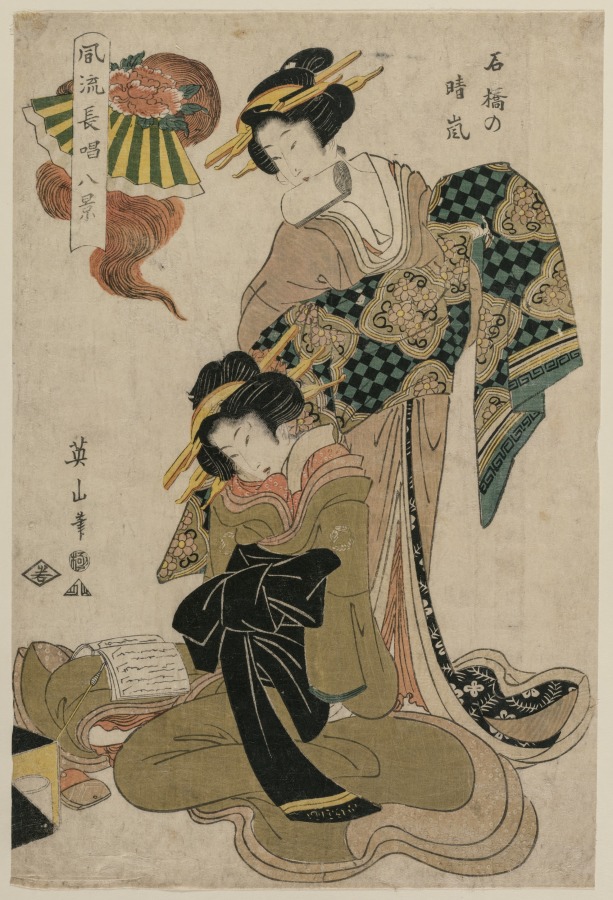
Haze on a Clear Day at Stone Bridge (From the series Eight Elegant Views of Chanted Accompanimnets for Kabuki Plays)
- Date:
- early 1810s
- Medium:
- color woodblock print
- Source:
- Cleveland Museum of Art
Description
Haze on a Clear Day at Stone Bridge, from the series Eight Elegant Views of Chanted Accompaniments for Kabuki Plays, dated about 1810 in the Cleveland Museum of Art's catalog, demonstrates how Kikukawa Eizan adapted the Eight Views convention to the urban entertainments of Edo. The series titles its eight prints after kabuki accompaniments — the chanted, musical, and percussive elements that organize the action onstage — and pairs each with one of the canonical Eight Views moments (autumn moon, evening snow, returning sails, evening bell, sunset glow, night rain, returning geese, and the haze on a clear day represented here). 'Stone Bridge' (Shakkyo) refers in turn to a famous kabuki and noh piece in which a lion dances on a stone bridge. The image is a triple mitate: Edo bijin-ga conventions, the Eight Views landscape sequence, and the kabuki accompaniment cycle all collapse into a single sheet. Eizan's figure, with the elongated proportions and dense patterning of the Kikukawa school, replaces the canonical landscape with a posed beauty whose attributes evoke the named view. The play of layered references would have flattered print buyers steeped in both classical poetry and the contemporary kabuki repertoire. The Cleveland Museum of Art preserves the sheet as part of its substantial Eizan holdings; the record may be consulted at https://clevelandart.org/art/1940.720.
More Prints by Kikukawa Eizan

The Theater District in Sakai-cho (Sakai cho shibai), from the "Fashionable Eight Views of the Eastern Capital (Furyu Toto hakkei)"
c. 1824/29
Color woodblock print; oban

Beauty standing beside morning glories
c. 1814/17
Color woodblock print; center sheet of oban triptych (right sheet: 1963.613)

Returning Sails at Yabase (Yabase kihan), from the series "Fashionable Eight Views of Omi (Furyu Omi hakkei)"
c. 1814/17
Color woodblock print; oban

Enjoying the Evening Cool at Ryogoku Bridge (Ryogokubashi noryo), from the series "Fashionable Eight Views of Edo (Furyu Edo hakkei)"
early 19th century
Color woodblock print; oban
More Bridges Prints
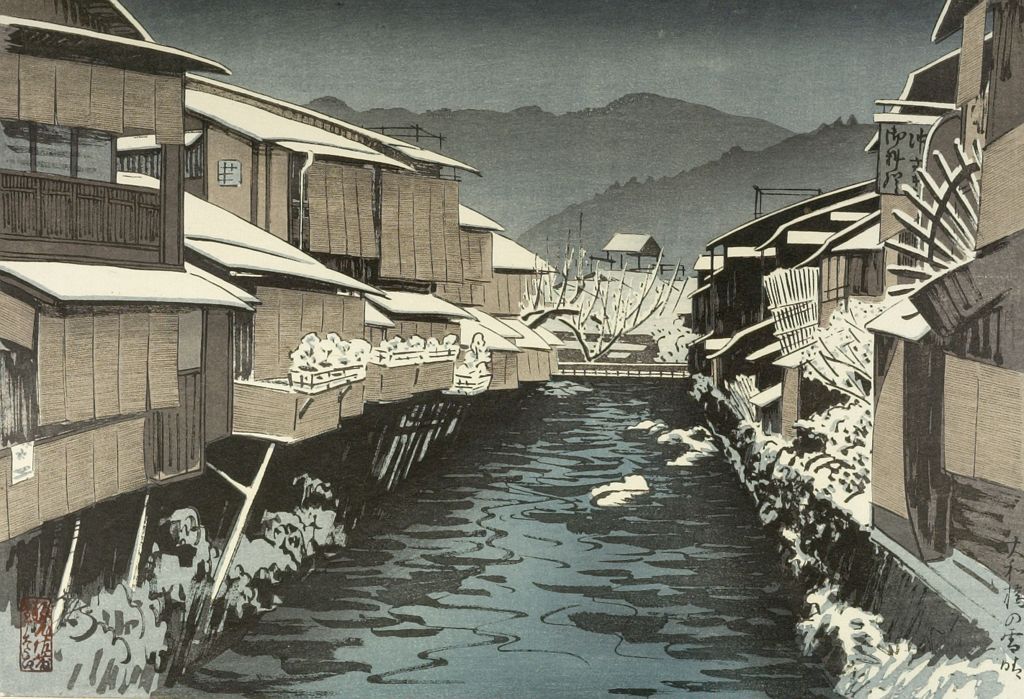
Fair Weather After Snow at Yamato Bridge, Kyoto (Yamato bashi no yukibare), Taishô period, dated 1924
Woodblock print
![Mount Fuji on a Moonlit Night, Kawai Bridge (Tsukiyo no Fuji [Kawaibashi]), from the series "Selection of Views of the Tokaido (Tokaido fukei senshu)" by Kawase Hasui](https://www.artic.edu/iiif/2/d0960668-1e73-339a-b182-fb995a54bff0/full/843,/0/default.jpg)
Mount Fuji on a Moonlit Night, Kawai Bridge (Tsukiyo no Fuji [Kawaibashi]), from the series "Selection of Views of the Tokaido (Tokaido fukei senshu)"
1947
Color woodblock print; oban

Shin Ohashi Bridge (Shin Ohashi), from the series "Twenty View of Tokyo (Tokyu nijukkei)"
1926
Color woodblock print; oban

Sacred Bridge in Nikko (Nikko Shinkyo)
1930
Color woodblock print; oban
Frequently Asked Questions
Haze on a Clear Day at Stone Bridge (From the series Eight Elegant Views of Chanted Accompanimnets for Kabuki Plays) was created by Kikukawa Eizan (菊川英山) in early 1810s.
Haze on a Clear Day at Stone Bridge (From the series Eight Elegant Views of Chanted Accompanimnets for Kabuki Plays) depicts bridges.