Blue Fuji
- Medium:
- Mokuhanga (Japanese woodblock)
- Image courtesy of
- Saru Gallery
Description
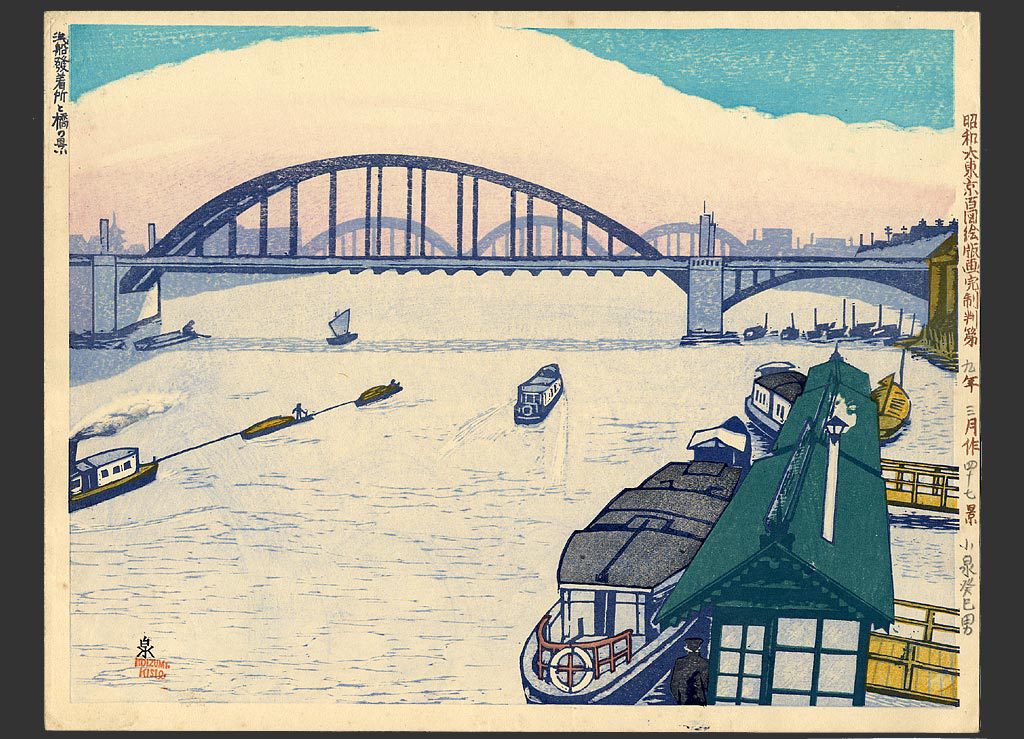
The print confines its palette to graduated blues to render Mount Fuji, treating the mountain as a tonal study rather than a chromatic one. [Bokashi](/glossary/bokashi) gradient printing — pigment wiped unevenly across the block to produce a smooth transition — is the central technique here, with darker indigo at the base shading toward paler tones near the summit, or the reverse, depending on atmospheric reading. The reduction to a single hue puts greater weight on form: the mountain's silhouette, the angle of its ridges, and the slope of its base must carry the composition without color contrast to assist. The treatment engages the long iconographic tradition of Fuji-as-subject in Japanese printmaking, with Hokusai's Aka Fuji (Red Fuji) as the obvious chromatic counterpart. For Koizumi, who designed, carved, and printed each block himself, a single-color bokashi study tests the [surishi](/glossary/surishi)'s discipline as much as the designer's compositional eye, embodying the [sosaku-hanga](/glossary/sosaku-hanga) principle of unified authorship.


![Kiba Lumberyard along the River at Fukugawa (New Edition) [Fukagawa-ku, kiba no kawasuji (shinpan)], from the series "One Hundred Views of Great Tokyo in the Showa Era (Showa dai Tokyo fukei hyaku zue hanga)" by Kishio Koizumi](https://www.artic.edu/iiif/2/f6380c15-6d23-c26a-899d-08ead4db792b/full/843,/0/default.jpg)