
Nihonbashi
- Medium:
- Mokuhanga (Japanese woodblock)
- Image courtesy of
- Saru Gallery
Description
Nihonbashi -- the bridge that anchored Edo's commercial heart and served as the zero-milestone for the Tokaido road -- had been a print subject since Hokusai and Hiroshige first treated it in the early nineteenth century. Koizumi inherits that lineage but records the bridge in its 1911 stone form, the granite arches and bronze ornaments rendered through the precise keyblock outlines and flat color registration of his hand-printed mokuhanga. The composition allows both the structural span and the surrounding commercial buildings to register, the bridge framed not as romantic vista but as a particular architectural fact. Working alone -- carving, printing, and publishing his own blocks in the sosaku-hanga manner -- Koizumi nonetheless treats Nihonbashi with the topographic seriousness of the older shin-hanga meisho-e tradition. The subject is a fixed point in his Dai Tokyo Hyakkei (One Hundred Views of Great Tokyo, 1928-1940), the city's nominal center recorded between earthquake reconstruction and wartime erasure.
More Prints by Kishio Koizumi
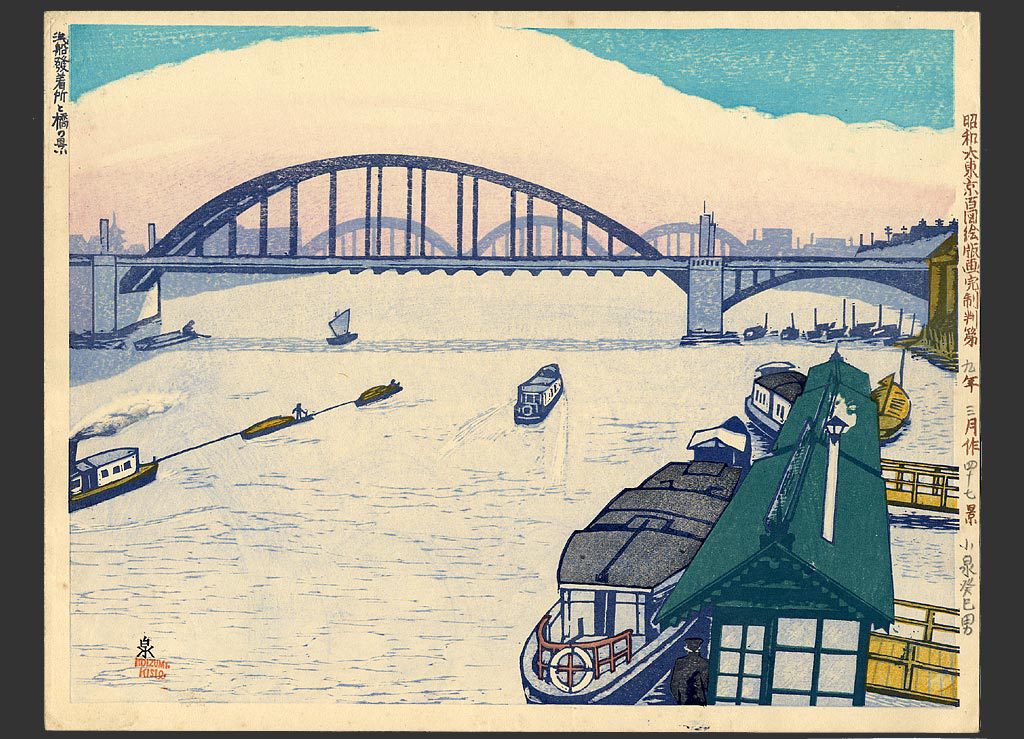
Untitled (kishio-koizumi)
Woodblock print
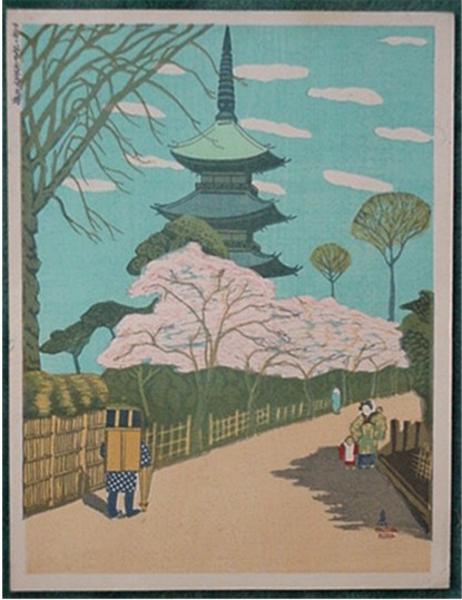
Unknown, spring scene
Woodblock print

Raft In Yoryoko River
Mokuhanga (Japanese woodblock)

Autumn Color along the Moat at Hanzo Gate (Hanzomon go-horihata no aki iro), from the series "One Hundred Views of Great Tokyo in the Showa Era (Showa dai Tokyo fukei hyaku zue hanga)"
1934
Color woodblock print; oban
Featured in Collections
Curated cross-cuts that include this print.
Frequently Asked Questions
Nihonbashi was created by Kishio Koizumi (小泉癸巳男).