
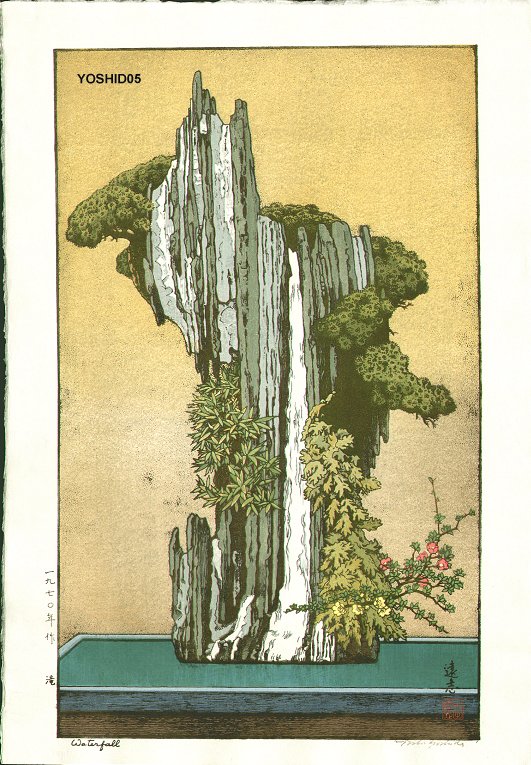
Waterfall
- Medium:
- Mokuhanga (Japanese woodblock)
- Image courtesy of
- Saru Gallery
Description
A study of falling water within Koizumi's broader landscape practice, the print likely depicts one of the cascades in the mountains west of Tokyo — sites such as Otaki, Hossawa, or Nunobiki that drew printmakers throughout the Edo and modern periods. Waterfalls present a particular technical challenge in mokuhanga: the white sheet of falling water must be reserved through registration, then surrounded by the carved keyblock and color blocks that define the rock face, vegetation, and pool below. Koizumi's solution would have applied bokashi gradation across the rock surfaces and the spray at the base, leaving the falling water as untouched washi to convey luminosity. As a sosaku-hanga practitioner, he carved every block himself, which gave him direct control over the keyblock lines that articulate the water's movement and the rocks' striations. The waterfall subject sits within a long ukiyo-e tradition extending through Hokusai's Waterfalls of Various Provinces of c. 1833, but Koizumi's handling reflects his individual carving and printing methods rather than collaborative studio production.
More Prints by Kishio Koizumi
Untitled (kishio-koizumi)
Woodblock print
Unknown, spring scene
Woodblock print

Raft In Yoryoko River
Mokuhanga (Japanese woodblock)

Autumn Color along the Moat at Hanzo Gate (Hanzomon go-horihata no aki iro), from the series "One Hundred Views of Great Tokyo in the Showa Era (Showa dai Tokyo fukei hyaku zue hanga)"
1934
Color woodblock print; oban
More Waterfalls Prints


Featured in Collections
Curated cross-cuts that include this print.
Frequently Asked Questions
Waterfall was created by Kishio Koizumi (小泉癸巳男).
Waterfall depicts waterfalls.