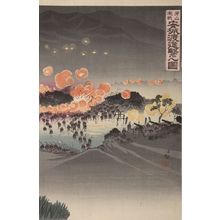
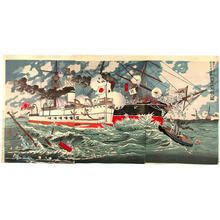
Crossing Anjô Proceeding in Battle (Anjô o watari shingeki no zu), Meiji period, dated 1894
- Medium:
- Woodblock print
- Source:
- Harvard Art Museum
- Image courtesy of
- Harvard Art Museum
Description
This print belongs to Kiyochika's series depicting engagements of the First Sino-Japanese War (1894–95), a body of work that established him as the foremost woodblock chronicler of that conflict. The crossing of Anju, located in the Pyongan region of Korea, was among the early military actions of the campaign as Japanese forces advanced northward toward the Yalu River. Kiyochika's composition likely shows Japanese infantry or cavalry crossing a river under conditions of active engagement, with uniforms, equipment, and formation rendered with the journalistic specificity that characterizes his sensō-e work from this period. Unlike his early Meiji atmospheric landscapes in the kosen-ga mode, these war prints favor high-contrast, legible compositions designed for rapid visual comprehension and mass distribution. Issued as large-format triptychs or single sheets sold individually, they reached audiences across Japan within weeks of the battles they depicted. The 1894 date places this among the earliest prints in Kiyochika's war series, produced while the outcome of the campaign remained uncertain.
More Prints by Kobayashi Kiyochika
More Warriors Prints
Benkei Bridge
Woodblock print

Saishin, from the series "Fashionable Women as the One Hundred and Eight Heroes of the Water Margin (Fuzoku onna Suikoden, ippyakuhachinin no uchi)"
c. 1828/30
Color woodblock print; surimono
Herakles, Shôwa period, dated 1965?
Woodblock print
Chüshingura in Twelve Months
Woodblock print
Featured in Collections
Curated cross-cuts that include this print.
Frequently Asked Questions
Crossing Anjô Proceeding in Battle (Anjô o watari shingeki no zu), Meiji period, dated 1894 was created by Kobayashi Kiyochika (小林清親).
Crossing Anjô Proceeding in Battle (Anjô o watari shingeki no zu), Meiji period, dated 1894 depicts warriors.