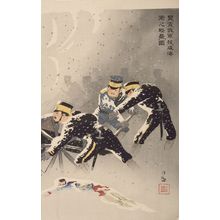
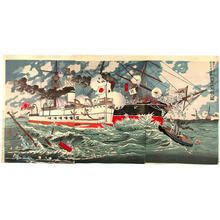
Despite the Snow the Japanese Army Perseveres to Hold Their Strong Position at Wei-hai-wei (Yuki o okashite waga gun Ikaiei no kenrui o nuku zu), Meiji period, dated 1895
- Medium:
- Woodblock print
- Source:
- Harvard Art Museum
- Image courtesy of
- Harvard Art Museum
Description
This sensō-e records the Japanese Army's assault on Wei-hai-wei (Weihaiwei), the fortified Chinese naval base in Shandong Province, during the First Sino-Japanese War. The battle, fought in late January and early February 1895, saw Japanese forces overcome the base's defenses in harsh winter conditions. The Japanese title—Yuki o okashite waga gun Ikaiei no kenrui o nuku zu—emphasizes the army's perseverance through snowfall, a framing aligned with the celebratory tone characteristic of wartime sensō-e. Kiyochika contributed extensively to this genre during the 1894–95 conflict, applying his atmospheric lighting methods to battle subjects: snow-covered ground provides a luminous base against which figures, smoke, and structural forms are silhouetted. The winter setting at Weihaiwei offered natural conditions well suited to the tonal contrasts central to his approach. Multiple impressions of this composition are known, reflecting the high market demand for illustrated battle prints during the closing months of the war, just before the Treaty of Shimonoseki ended hostilities in April 1895.
More Prints by Kobayashi Kiyochika
More Snow Scenes Prints
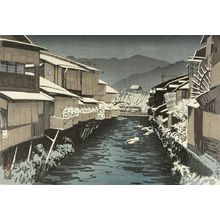
Fair Weather After Snow at Yamato Bridge, Kyoto (Yamato bashi no yukibare), Taishô period, dated 1924
Woodblock print

The Compound of the Tenman Shrine at Kameido in the Snow (Kameido Tenmangu keidai no yuki), from the series "Famous Places in the Eastern Capital (Toto meisho)"
c. 1832/38
Color woodblock print; oban

Miyajima in Snow (Yuki no Miyajima)
Yuki no Miyajima
1929
Color woodblock print; oban
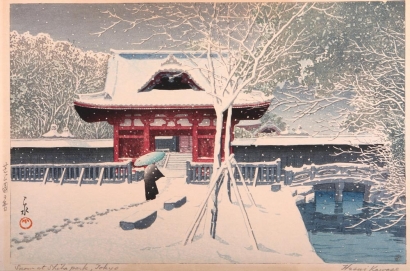
Evening Snow at Shiha Park, Tokyo
1932
Woodblock print
Frequently Asked Questions
Despite the Snow the Japanese Army Perseveres to Hold Their Strong Position at Wei-hai-wei (Yuki o okashite waga gun Ikaiei no kenrui o nuku zu), Meiji period, dated 1895 was created by Kobayashi Kiyochika (小林清親).
Despite the Snow the Japanese Army Perseveres to Hold Their Strong Position at Wei-hai-wei (Yuki o okashite waga gun Ikaiei no kenrui o nuku zu), Meiji period, dated 1895 depicts snow scenes.