![[Humorous picture showing Chinese religious practices (Raijin, the Japanese God of Thunder, ranting to a crowd of Chinese Buddhist worshippers)] by Kobayashi Kiyochika — Japanese Woodblock print](https://data.ukiyo-e.org/loc/thumbs/00985v.jpg)
[Humorous picture showing Chinese religious practices (Raijin, the Japanese God of Thunder, ranting to a crowd of Chinese Buddhist worshippers)]
- Medium:
- Woodblock print
- Source:
- Library of Congress
- Image courtesy of
- Library of Congress
Description
A satirical ponchi-e in which Raijin, the Japanese Shinto and Buddhist deity of thunder, appears before a gathered crowd of Chinese Buddhist worshippers. Kiyochika's humor operates on the premise of religious misrecognition — the Chinese devotees mistake the Japanese thunder god for a figure within their own tradition, or are shown unable to distinguish between divine traditions. Raijin is rendered with his characteristic drum ring and fierce expression, drawn from established Japanese iconographic convention. The crowd of Chinese figures is depicted in caricatural form consistent with other prints in Kiyochika's Sino-Japanese War series. This print reflects a broader Meiji-era tendency to cast Japanese cultural and religious forms as superior to their Chinese counterparts, framing the war as a civilizational as well as military contest. The composition uses multiple registers to separate Raijin from the worshippers below.
More Prints by Kobayashi Kiyochika
More Snow Scenes Prints
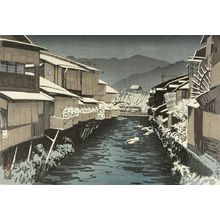
Fair Weather After Snow at Yamato Bridge, Kyoto (Yamato bashi no yukibare), Taishô period, dated 1924
Woodblock print

The Compound of the Tenman Shrine at Kameido in the Snow (Kameido Tenmangu keidai no yuki), from the series "Famous Places in the Eastern Capital (Toto meisho)"
c. 1832/38
Color woodblock print; oban

Miyajima in Snow (Yuki no Miyajima)
Yuki no Miyajima
1929
Color woodblock print; oban
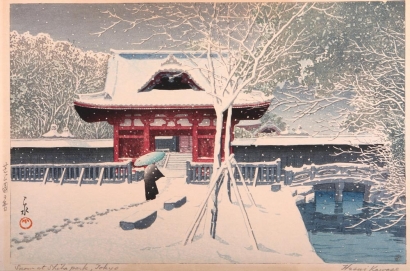
Evening Snow at Shiha Park, Tokyo
1932
Woodblock print
Frequently Asked Questions
[Humorous picture showing Chinese religious practices (Raijin, the Japanese God of Thunder, ranting to a crowd of Chinese Buddhist worshippers)] was created by Kobayashi Kiyochika (小林清親).
[Humorous picture showing Chinese religious practices (Raijin, the Japanese God of Thunder, ranting to a crowd of Chinese Buddhist worshippers)] depicts snow scenes.