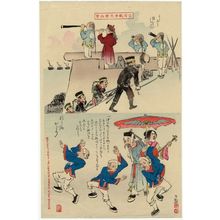
No Eyes at the Back (Ushiro ni me nashi), and Dance of Cowardice (Okubyô odori), from the series Comical Art Exhibit of the Sino-Japanese War (Nissei sensô shôraku gakai)
- Medium:
- Woodblock print
- Source:
- Museum of Fine Arts Boston
- Image courtesy of
- Museum of Fine Arts Boston
Description
This print from the satirical series Nissei sensô shôraku gakai (Comical Art Exhibit of the Sino-Japanese War) presents two vignettes — No Eyes at the Back (Ushiro ni me nashi) and Dance of Cowardice (Okubyô odori) — mocking Chinese military performance during the 1894–95 war. Kiyochika produced numerous ponchi-e (caricature prints) throughout his career, and the Sino-Japanese War prompted an outpouring of propagandistic humor. The first image likely depicts Chinese soldiers in panicked retreat, unaware of what pursues them from behind. The second illustrates a chaotic, undignified flight rendered as absurdist choreography. The compositions would employ exaggerated physiognomy and deliberately awkward postures in contrast to the composed bearing of Japanese figures in his straight war prints. Such satirical diptych or vignette formats were common in Meiji-era newspaper supplements and print series. This print documents the nationalistic and often racially charged visual rhetoric that accompanied Japanese military victories and the broader Meiji project of positioning Japan as a modern imperial power.
More Prints by Kobayashi Kiyochika
More Snow Scenes Prints
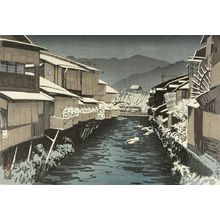
Fair Weather After Snow at Yamato Bridge, Kyoto (Yamato bashi no yukibare), Taishô period, dated 1924
Woodblock print

The Compound of the Tenman Shrine at Kameido in the Snow (Kameido Tenmangu keidai no yuki), from the series "Famous Places in the Eastern Capital (Toto meisho)"
c. 1832/38
Color woodblock print; oban

Miyajima in Snow (Yuki no Miyajima)
Yuki no Miyajima
1929
Color woodblock print; oban
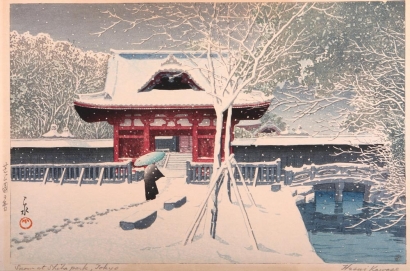
Evening Snow at Shiha Park, Tokyo
1932
Woodblock print
Frequently Asked Questions
No Eyes at the Back (Ushiro ni me nashi), and Dance of Cowardice (Okubyô odori), from the series Comical Art Exhibit of the Sino-Japanese War (Nissei sensô shôraku gakai) was created by Kobayashi Kiyochika (小林清親).
No Eyes at the Back (Ushiro ni me nashi), and Dance of Cowardice (Okubyô odori), from the series Comical Art Exhibit of the Sino-Japanese War (Nissei sensô shôraku gakai) depicts snow scenes.