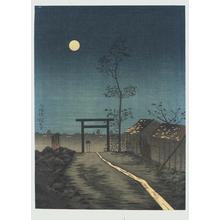
Taro-inari Shrine at Asakusa
- Medium:
- Woodblock print
- Source:
- Japanese Art Open Database
- Image courtesy of
- Japanese Art Open Database
Description
This composition presents another view of the Taro Inari Shrine in the Asakusa district, which Kiyochika documented across multiple prints as part of his broader project recording Tokyo's traditional sacred sites against the backdrop of rapid Meiji-era modernization. The Inari cult, associated with rice cultivation, commerce, and foxes as divine messengers, maintained a strong following in the eastern districts of the city. Kiyochika's treatment characteristically prioritizes atmospheric effects over topographical accuracy, using the flat terrain of the Asakusa ricefields to construct compositions dominated by sky and reflected light. The oban-format print demonstrates his fusion of Western tonal modeling—absorbed through his study of Western-style painting under Takahashi Yuichi and Charles Wirgman—with the technical vocabulary of woodblock printing, achieving luminous effects through layered ink applications and careful bokashi blending.
More Prints by Kobayashi Kiyochika
More Temples & Shrines Prints
Fushimi Inari Temple
伏見稲荷
Woodblock print

The Compound of the Tenman Shrine at Kameido in the Snow (Kameido Tenmangu keidai no yuki), from the series "Famous Places in the Eastern Capital (Toto meisho)"
c. 1832/38
Color woodblock print; oban
Temple with lanterns
Woodblock print

A Section of the Byodo Temple at Uji (Uji Byodoin no ichibu), from the series "Souvenirs of Travel, Second Series (Tabi miyage dai nishu)"
Uji Byodoin no ichibu
1921
Color woodblock print; oban
Featured in Collections
Curated cross-cuts that include this print.
Frequently Asked Questions
Taro-inari Shrine at Asakusa was created by Kobayashi Kiyochika (小林清親).
Taro-inari Shrine at Asakusa depicts temples & shrines.