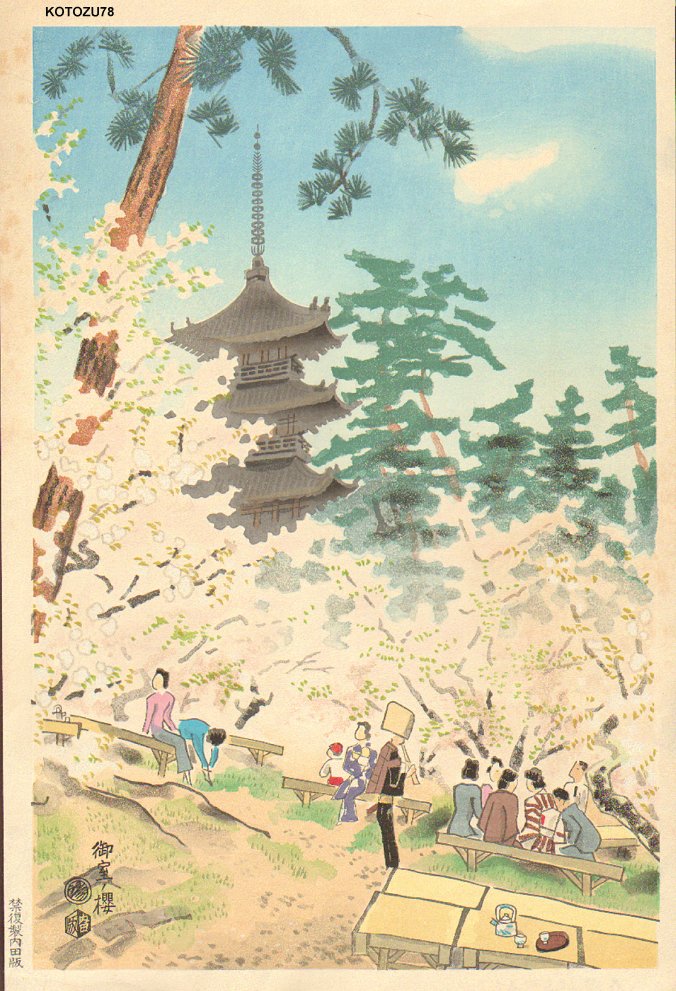
Omuro Pagoda
- Medium:
- Woodblock print
- Source:
- Watanabe Print
- Image courtesy of
- Watanabe Print
Description
Ninna-ji temple in the Omuro district of northwestern Kyoto possesses a five-story pagoda erected in the late seventeenth century, one of the few Edo-period pagodas surviving in Kyoto and a designated National Treasure. The pagoda rises from a broad stone base surrounded by the temple's extensive cherry orchard—the Omuro cherries (Omuro no Sakura) are a celebrated late-blooming variety—making it among the most painted and printed landmarks in the city. Without seasonal foliage, this composition would emphasize the pagoda's architectural geometry: the diminishing eave tiers, the finial, and the precise interlocking of bracket systems. Kotozuka's carvers would have spent considerable effort on the linework defining each tier's bracketing and curved eave edges, while the color blocks supply the warm gray of aged tile and the soft tones of the surrounding cypress and pine.
More Prints by Kotozuka Eiichi
More Temples & Shrines Prints
Fushimi Inari Temple
伏見稲荷
Woodblock print

The Compound of the Tenman Shrine at Kameido in the Snow (Kameido Tenmangu keidai no yuki), from the series "Famous Places in the Eastern Capital (Toto meisho)"
c. 1832/38
Color woodblock print; oban
Temple with lanterns
Woodblock print

A Section of the Byodo Temple at Uji (Uji Byodoin no ichibu), from the series "Souvenirs of Travel, Second Series (Tabi miyage dai nishu)"
Uji Byodoin no ichibu
1921
Color woodblock print; oban
Featured in Collections
Curated cross-cuts that include this print.
Frequently Asked Questions
Omuro Pagoda was created by Kotozuka Eiichi (琴塚英一).
Omuro Pagoda depicts temples & shrines.