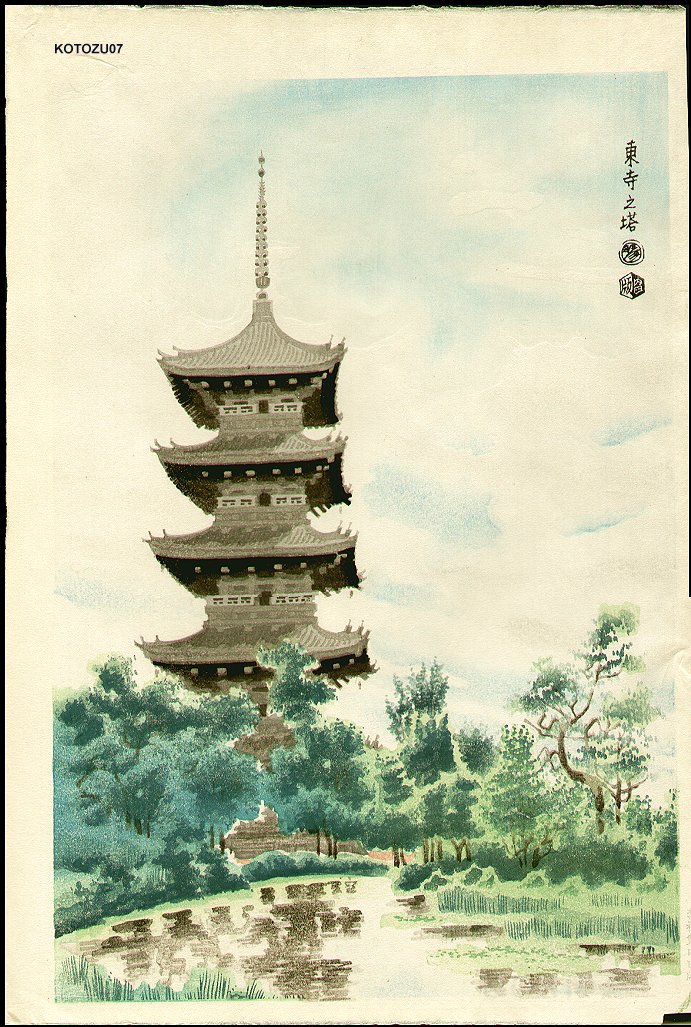
Toji Pagoda in Kyoto
- Medium:
- Woodblock print
- Source:
- Watanabe Print
- Image courtesy of
- Watanabe Print
Description
Tō-ji temple's five-story pagoda in Kyoto's Minami ward is the tallest surviving wooden pagoda in Japan at 54.8 meters. Built in 826 CE and reconstructed in its current form in 1644, it has defined the city's southern skyline for centuries. As a Kyoto-based artist working from a studio in the ancient capital, Kotozuka would have returned to this subject across different seasons. The composition likely positions the pagoda rising above the surrounding temple structures or above the cherry trees for which Tō-ji's spring market is known, using the pagoda's vertical mass as the organizing axis. The tiered, diminishing rooflines—each with turned-up eaves and finials—required careful multi-block registration to maintain structural clarity at different scales. Flat washes of dark gray-green or brown-ochre for the roof tiles against a pale bokashi sky were characteristic of Kotozuka's architectural treatments, giving the heavy masonry and tile forms a weight and materiality suited to the woodblock medium.
More Prints by Kotozuka Eiichi
More Temples & Shrines Prints
Fushimi Inari Temple
伏見稲荷
Woodblock print

The Compound of the Tenman Shrine at Kameido in the Snow (Kameido Tenmangu keidai no yuki), from the series "Famous Places in the Eastern Capital (Toto meisho)"
c. 1832/38
Color woodblock print; oban
Temple with lanterns
Woodblock print

A Section of the Byodo Temple at Uji (Uji Byodoin no ichibu), from the series "Souvenirs of Travel, Second Series (Tabi miyage dai nishu)"
Uji Byodoin no ichibu
1921
Color woodblock print; oban
Featured in Collections
Curated cross-cuts that include this print.
Frequently Asked Questions
Toji Pagoda in Kyoto was created by Kotozuka Eiichi (琴塚英一).
Toji Pagoda in Kyoto depicts temples & shrines.