
Ginkaku-ji temple
- Medium:
- Mokuhanga (Japanese woodblock)
- Image courtesy of
- Saru Gallery
Description
Ginkaku-ji, the Temple of the Silver Pavilion, is a Rinzai Zen complex in the Higashiyama district of Kyoto, founded as a retirement villa by the shogun Ashikaga Yoshimasa in 1482 and converted to a Buddhist temple after his death. Despite the name, the pavilion was never silvered; the building presents dark timber against white plaster, set within a garden that includes the raked sand cone known as Kogetsudai and the sand expanse Ginshadan. Prints of Ginkaku-ji typically frame the two-storey pavilion among pine and maple foliage, with the pond in the foreground or the garden's geometric sand forms providing structural counterpoint. Mokuhanga renders the architecture through fine key-block linework for eaves, lattice windows, and railings, with broader color blocks for the roof, plaster walls, and surrounding planting. Bokashi gradients carry the transition between sky, foliage, and water surface. As a meisho-e subject, Ginkaku-ji places Maeda Toshiro's print within the tradition of Kyoto temple imagery in Japanese woodblock printing.
More Prints by Maeda Toshiro




More Temples & Shrines Prints
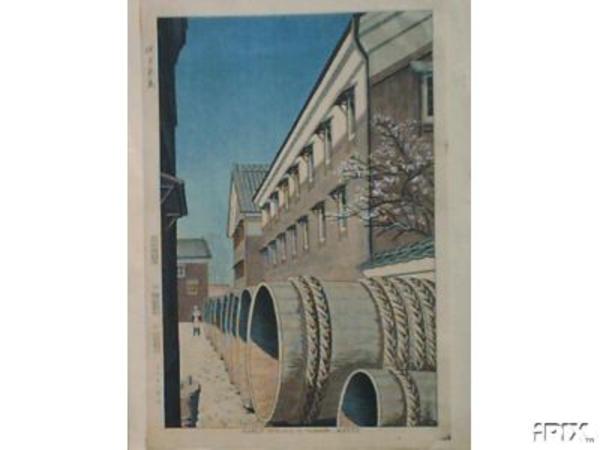
Fushimi Inari Temple
伏見稲荷
Woodblock print

The Compound of the Tenman Shrine at Kameido in the Snow (Kameido Tenmangu keidai no yuki), from the series "Famous Places in the Eastern Capital (Toto meisho)"
c. 1832/38
Color woodblock print; oban
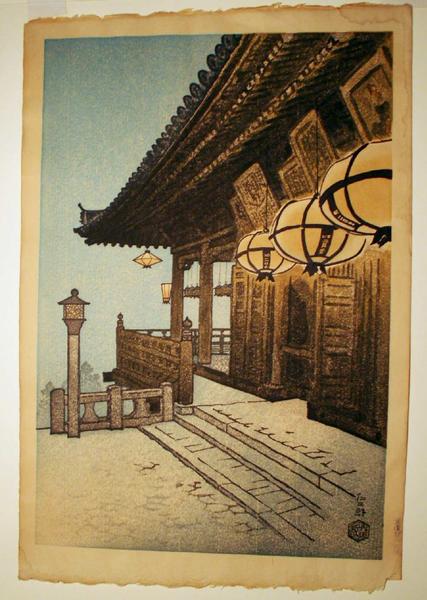
Temple with lanterns
Woodblock print

A Section of the Byodo Temple at Uji (Uji Byodoin no ichibu), from the series "Souvenirs of Travel, Second Series (Tabi miyage dai nishu)"
Uji Byodoin no ichibu
1921
Color woodblock print; oban
Featured in Collections
Curated cross-cuts that include this print.
Frequently Asked Questions
Ginkaku-ji temple was created by Maeda Toshiro (前田藤四郎).
Ginkaku-ji temple depicts temples & shrines.