
Malay Beauty
- Medium:
- Mokuhanga (Japanese woodblock)
- Image courtesy of
- Saru Gallery
Description
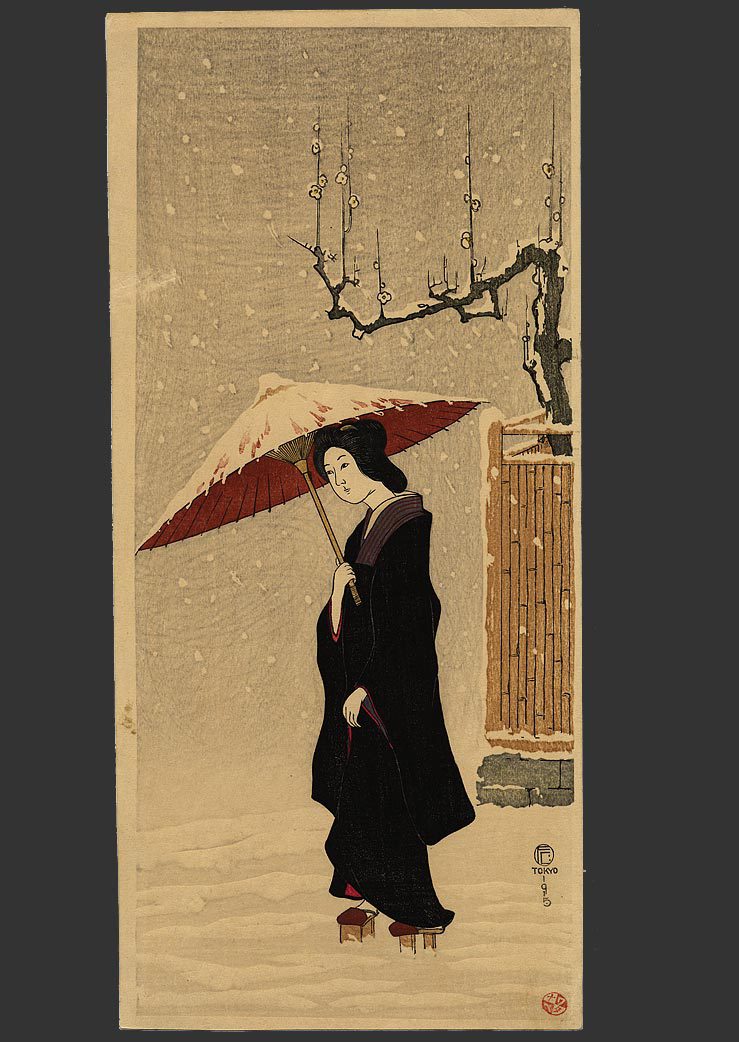
The Malay tag identifies this as a bijin-ga of a woman from the Malay world — likely encountered at a port-of-call on the sea passage between Japan and Europe through the South China Sea and the Strait of Malacca. Bijin-ga as a genre is rooted in Edo printmaking, where it depicted courtesans and townswomen of Japan; transposing it onto a Malay sitter is a sosaku-hanga gesture, opening a centuries-old pictorial type to non-Japanese subjects. A print of this kind typically frames the head and shoulders or a half-length figure, with the key block describing the contours of face, hair, and dress, and color blocks carrying skin tones and patterned textile. Nagase's training in nihonga and Western painting equipped him to handle facial structure in ways that traditional ukiyo-e bijin-ga, with their stylized features, did not pursue. The print sits within his travel-period output and reflects the interwar Japanese interest in the peoples encountered along the maritime routes opened by steamship travel.
More Prints by Nagase Yoshio
![Title unknown [Woman and child] by Nagase Yoshio](https://1.api.artsmia.org/800/135555.jpg)

More Bijin-ga Prints

Featured in Collections
Curated cross-cuts that include this print.
Frequently Asked Questions
Malay Beauty was created by Nagase Yoshio (永瀬義郎).
Malay Beauty depicts bijin-ga.