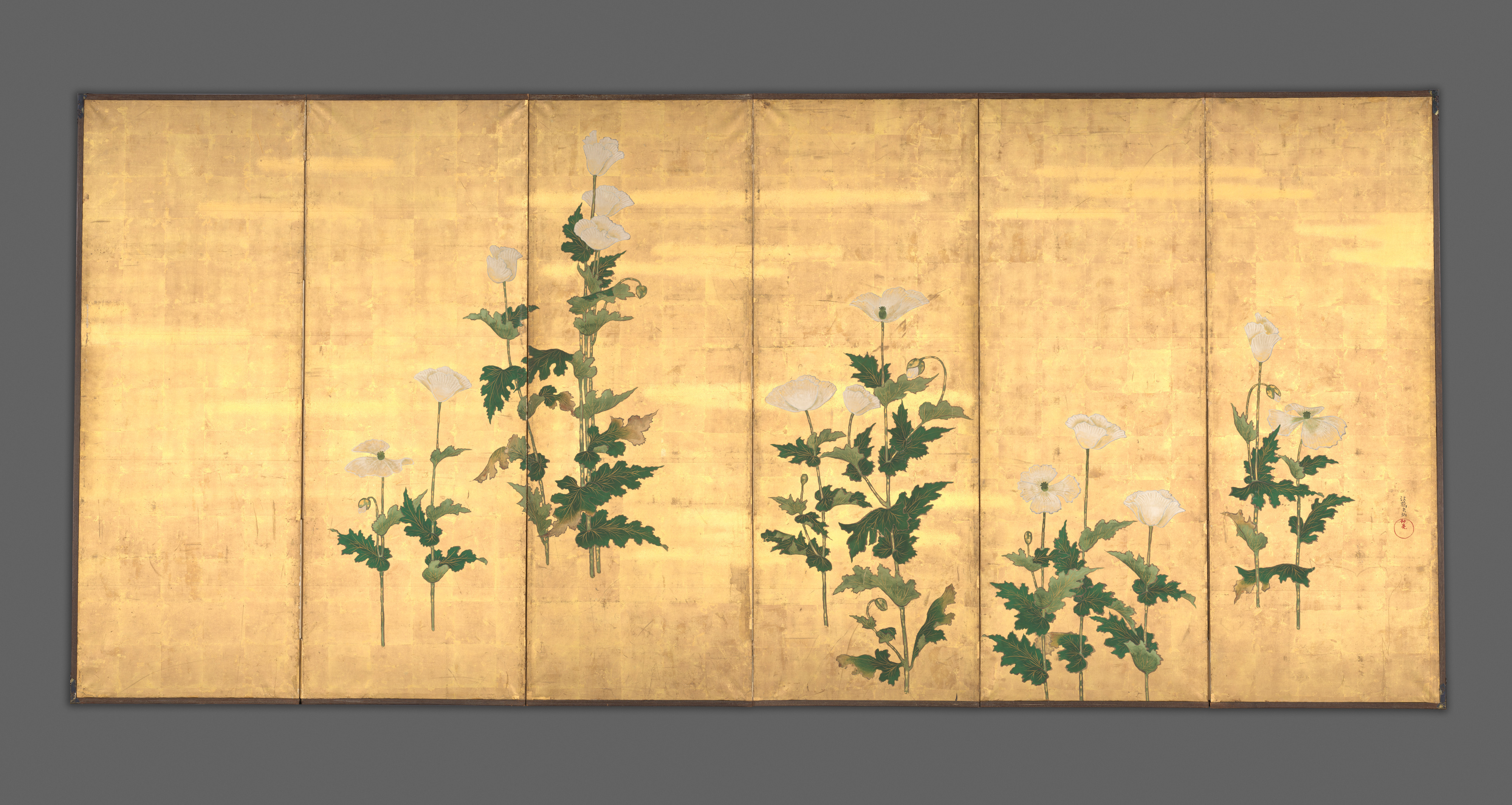
White Poppies on Gold Ground
白芥子図屏風
by Ogata Kōrin
- Date:
- Edo period (1615–1868)
- Medium:
- Six-panel folding screen; color on paper
- Source:
- The Metropolitan Museum of Art
Description
White Poppies on Gold Ground (Hakukei-zu byōbu) is a six-panel folding screen by Ogata Kōrin in color on paper, executed in the mature decorative idiom of the artist's last years in Kyoto and now held in the collection of the Metropolitan Museum of Art, New York. The composition deploys clusters of white poppies in full bloom, leaves, and buds across a continuous horizontal field of gold leaf that turns the support itself into one of the colors of the painting; the flowers are arranged in irregular groupings along a low ground line, with the heads turned in different directions to catch the light and the leaves rendered in the tarashikomi technique of pooled wet pigment that Tawaraya Sōtatsu had pioneered in the early seventeenth century and that became Kōrin's principal mode of handling foliage. The choice of subject — the white poppy rather than the more conventional irises, plum, or chrysanthemum of the Rinpa repertoire — is one of the unusual features of the screen and reflects the broader interest in poppies that emerged in Genroku and post-Genroku Kyoto, partly through Chinese herbal and botanical sources and partly through the cultivation of poppies as ornamental garden plants in the great Kyoto residences. The screen exemplifies the way Kōrin's mature handling treats a single botanical subject as the basis for a long horizontal decorative composition, eliminating the spatial recession of conventional painting in favor of a flattened, almost graphic patterning that became one of the signatures of the Rinpa style and one of its most far-reaching contributions to later Japanese and European decorative arts.
More Prints by Ogata Kōrin

Frequently Asked Questions
White Poppies on Gold Ground (白芥子図屏風) was created by Ogata Kōrin (尾形光琳) in Edo period (1615–1868).