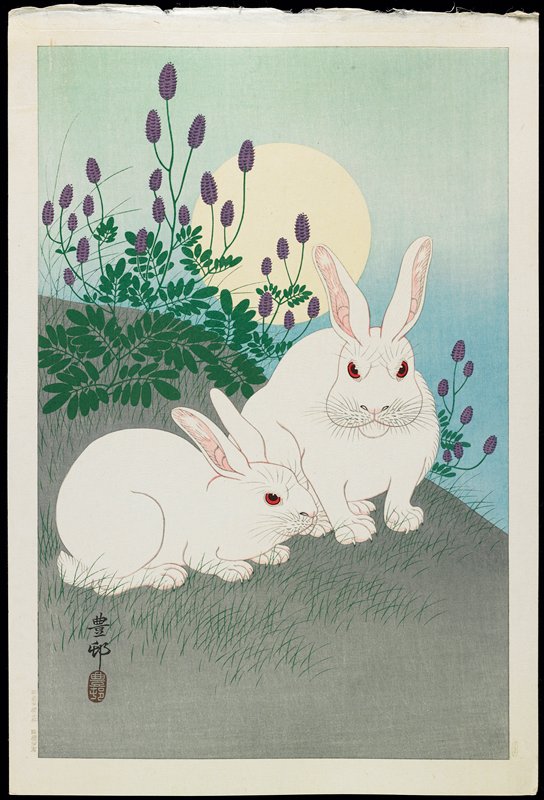
Two White Rabbits Under a Full Moon
by Ohara Koson
- Date:
- c. 1928–1930
- Medium:
- Woodblock print, ink and color on paper with embossing
- Format:
- Oban
- Dimensions:
- 36.2 × 24 cm
- Publisher:
- Watanabe Shozaburo
- Edition:
- Published by Watanabe Shozaburo
- Source:
- Minneapolis Institute of Art
Description
Two white rabbits crouch beneath a full moon — the lunar rabbits of East Asian mythology, the creatures believed to inhabit the moon and pound medicinal herbs with a mortar and pestle. Produced around 1928–1930 with embossing adding texture to the rabbits' fur and the moon's surface, this print engages one of East Asian culture's most beloved folk images. Koson's rabbits are simultaneously naturalistic — the animals rendered with anatomical care — and mythological, their placement under the full moon invoking the tradition that connects rabbit and moon across centuries of East Asian art.
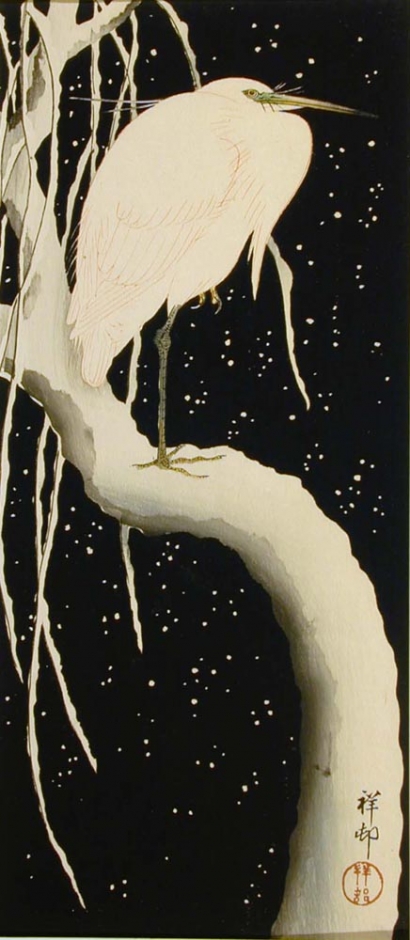
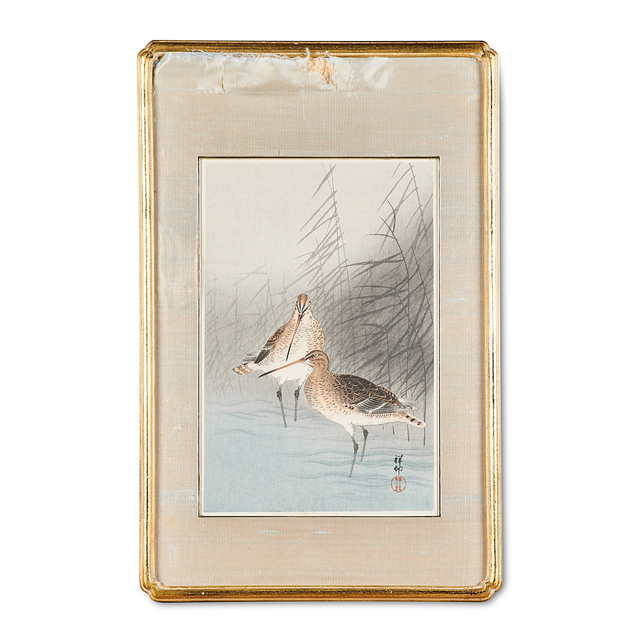
More Prints by Ohara Koson


More Moonlight Prints
![Mount Fuji on a Moonlit Night, Kawai Bridge (Tsukiyo no Fuji [Kawaibashi]), from the series "Selection of Views of the Tokaido (Tokaido fukei senshu)" by Kawase Hasui](https://www.artic.edu/iiif/2/d0960668-1e73-339a-b182-fb995a54bff0/full/843,/0/default.jpg)
Mount Fuji on a Moonlit Night, Kawai Bridge (Tsukiyo no Fuji [Kawaibashi]), from the series "Selection of Views of the Tokaido (Tokaido fukei senshu)"
1947
Color woodblock print; oban

Evening Moon at Nakanoshima, Sapporo (Sapporo Nakanoshima no yuzuki), from the series "Collection of Views of Japan, Eastern Japan Edition (Nihon fukei shu higashi Nihon hen)"
March 1933
Color woodblock print; oban

Matsushima in Moonlight (Tsuki no Matsushima)
1919
Color woodblock print

Kiyozumi Garden in Moonlight
January 1938
Woodblock print, ink and color on paper
Featured in Collections
Curated cross-cuts that include this print.
Frequently Asked Questions
Two White Rabbits Under a Full Moon was created by Ohara Koson (小原古邨) in c. 1928–1930.
Two White Rabbits Under a Full Moon uses Bokashi, on woodblock print, ink and color on paper with embossing.
Two White Rabbits Under a Full Moon was published by Watanabe Shozaburo (c. 1928–1930).
Two White Rabbits Under a Full Moon depicts moonlight and night scenes.
Two White Rabbits Under a Full Moon measures 36.2 × 24 cm (Oban format).