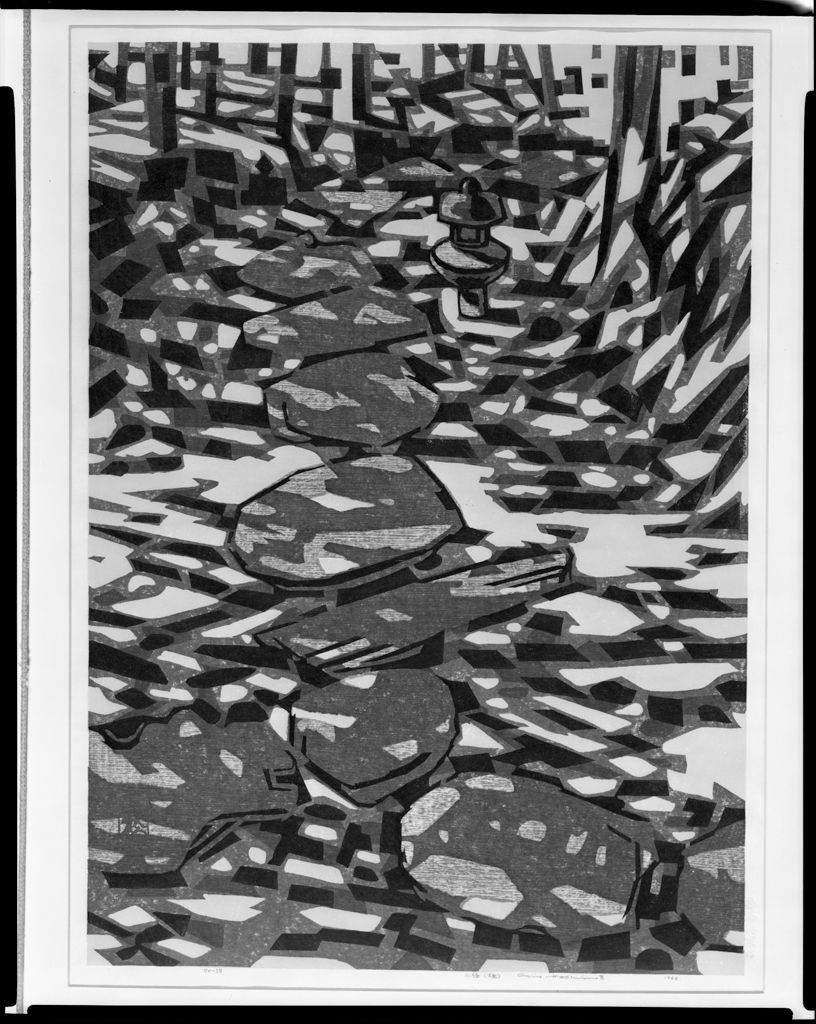
Katsura (Shôkei), Shôwa period, dated 1965
- Date:
- Shôwa period, 1926-1989
- Medium:
- Woodblock print
- Edition:
- Self-printed
- Source:
- Harvard Art Museums
Description
Katsura refers to Katsura Imperial Villa in Kyoto, a seventeenth-century retreat whose tea pavilions, stone paths, and pond garden have served Japanese architects and printmakers as an iconography of restraint. Shokei - pine view - points to a garden vista within the villa complex, framed through carefully placed pines and stepping stones. Hashimoto's 1965 treatment likely uses a low horizon and architectural fragment, perhaps a verandah edge, a shoji panel, or a stone lantern, to anchor the composition in the manner he had developed across his temple and shrine prints. His blocks of this period favored flat color fields with measured key-line carving, allowing the planar geometry of Japanese garden design to register clearly. Within his oeuvre, the Katsura subject belongs to a sustained engagement with Kyoto's monastery and villa gardens, where he treated landscaped space as an extension of architectural composition rather than as picturesque scenery.
More Prints by Okiie Hashimoto

More Landscapes Prints

Lake Kugushi in Wakasa Province (Wakasa Kugushiko), from the series Souvenirs of Travel I (Tabi miyage dai isshu)"
Wakasa Kugushiko
1920
Color woodblock print; oban
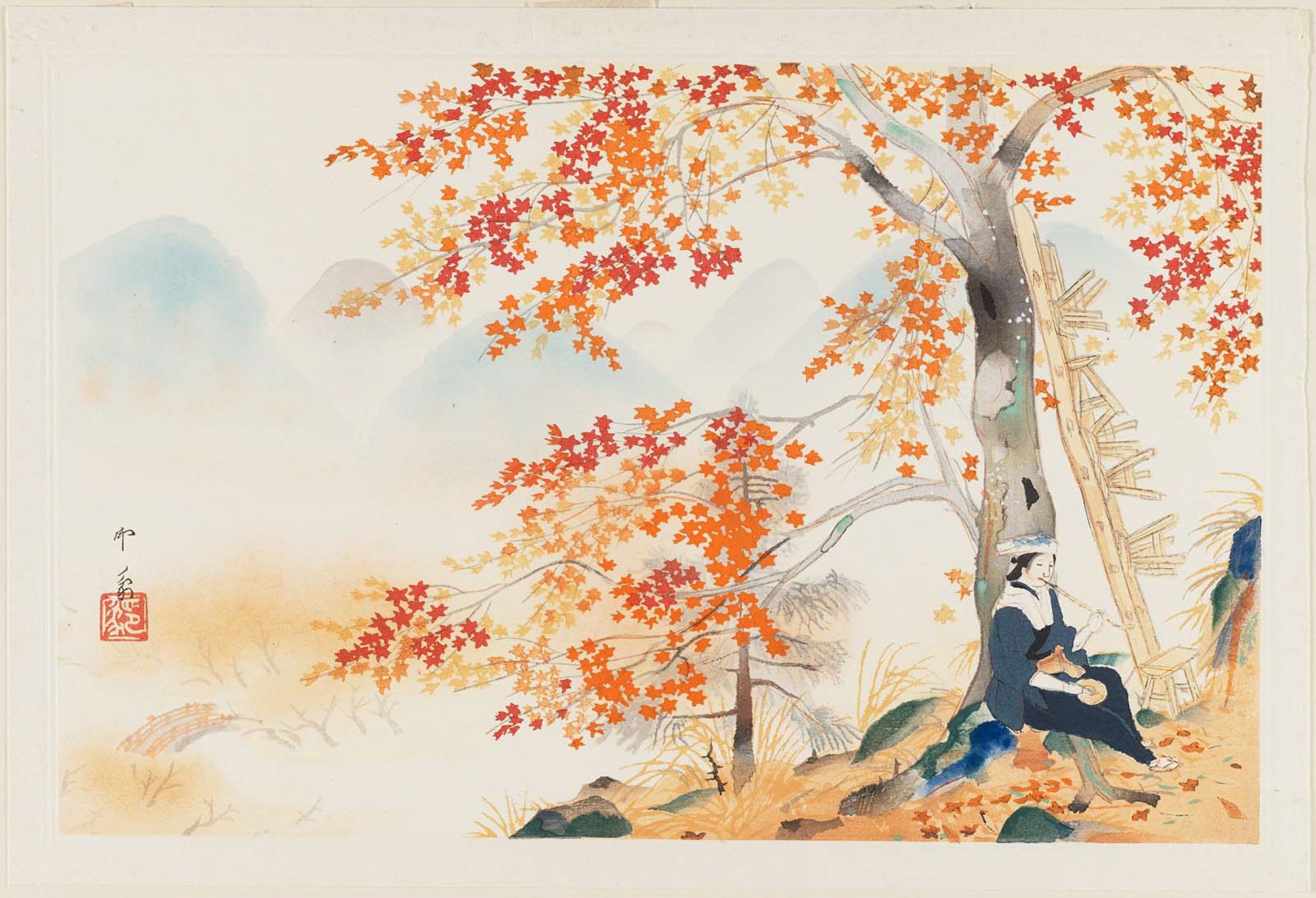
Autumn Maple Leaves at Takao, from the album Eight Views of Kyoto (Kyôto hakkei)
Woodblock print

The Beach at Kaiganji in Sanuki Province (Sanuki Kaiganji no hama), from the series "Collection of Views of Japan II, Kansai Edition (Nihon fukei shu II Kansai hen)"
1934
Color woodblock print; oban

Tea Kettle, section of a sheet from the series "Mirror of Stone Rubbings of Views of the Provinces" (Kohon meihitsu ishizuri kagami)
n.d.
Woodblock print; ishizuri-e, section of harimaze sheet
Featured in Collections
Curated cross-cuts that include this print.
Frequently Asked Questions
Katsura (Shôkei), Shôwa period, dated 1965 was created by Okiie Hashimoto (橋本興家) in Shôwa period, 1926-1989.
Katsura (Shôkei), Shôwa period, dated 1965 depicts landscapes, architecture, and gardens.