
Mt Fuji in the distance
- Medium:
- Mokuhanga (Japanese woodblock)
- Image courtesy of
- Saru Gallery
Description
Hashimoto places Fuji at the horizon and gives the foreground over to intervening landscape — likely fields, a village roofline, or a stand of trees through which the cone is glimpsed. This compositional move, common in Edo-period meisho-e, sets up a tension between the near, particular subject and the distant, archetypal one. In Hashimoto's hands the foreground is built from the carved planes characteristic of sosaku-hanga: visible knife strokes, deliberate woodgrain showing through flat color, and a restricted palette held to a few blocks. The mountain itself is typically reduced to two or three shapes — slope, snowcap, sky — separated by registration rather than by graded bokashi. Hashimoto carved and printed every impression himself in keeping with the sosaku-hanga creed of the artist as sole maker. Within his oeuvre, distant-Fuji compositions read as a counterpart to his close-up architectural studies: the same structural eye, applied at landscape scale rather than to a temple wall or castle keep.
More Prints by Okiie Hashimoto

More Mount Fuji Prints
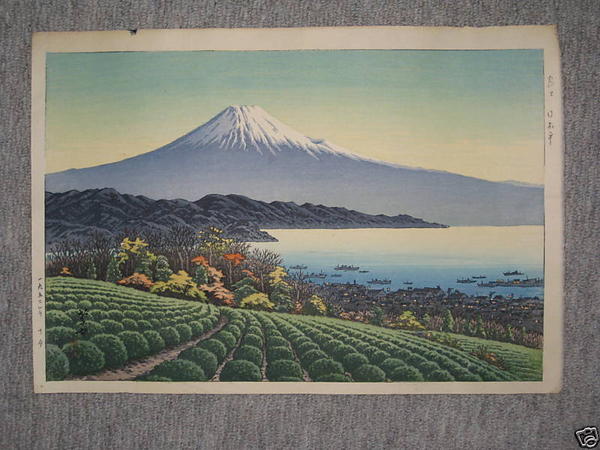
Fuji from tea farm
Woodblock print

Akasaka, Fujikawa, Okazaki, Chiryu, and Narumi, from the series "Famous Places on the Fifty-three Stations of the Tokaido, Five Stations (Tokaido gojusan eki goshuku meisho)"
c. 1830/35
Color woodblock print; oban
![Mount Fuji on a Moonlit Night, Kawai Bridge (Tsukiyo no Fuji [Kawaibashi]), from the series "Selection of Views of the Tokaido (Tokaido fukei senshu)" by Kawase Hasui](https://www.artic.edu/iiif/2/d0960668-1e73-339a-b182-fb995a54bff0/full/843,/0/default.jpg)
Mount Fuji on a Moonlit Night, Kawai Bridge (Tsukiyo no Fuji [Kawaibashi]), from the series "Selection of Views of the Tokaido (Tokaido fukei senshu)"
1947
Color woodblock print; oban

Mt. Fuji in Rain (Ame no Fuji)
n.d.
Color woodblock print
Featured in Collections
Curated cross-cuts that include this print.
Frequently Asked Questions
Mt Fuji in the distance was created by Okiie Hashimoto (橋本興家).
Mt Fuji in the distance depicts mount fuji.