
Mt Fuji seen from Mt Kobotoke
- Medium:
- Mokuhanga (Japanese woodblock)
- Image courtesy of
- Saru Gallery
Description
The print depicts Mount Fuji as viewed from the heights of Mount Kobotoke, the pass that historically marked the boundary between Musashi and Sagami provinces along the old Koshu Kaido. Hashimoto frames Fuji's conical silhouette against intervening ridgelines, employing the layered spatial recession common in his meisho-e of mountain subjects. The composition likely uses bokashi gradation in the sky and distant atmosphere to push Fuji into the background plane while keeping the foreground terrain solid and graphic. As a sosaku-hanga artist who designed, carved, and printed every block himself, Hashimoto applied his Western-trained sense of structural massing to landscape subjects throughout his career. Mount Fuji appears repeatedly in his oeuvre, treated less as the romantic icon of Edo-period ukiyo-e and more as a geometric form anchoring a measured arrangement of natural masses.
More Prints by Okiie Hashimoto
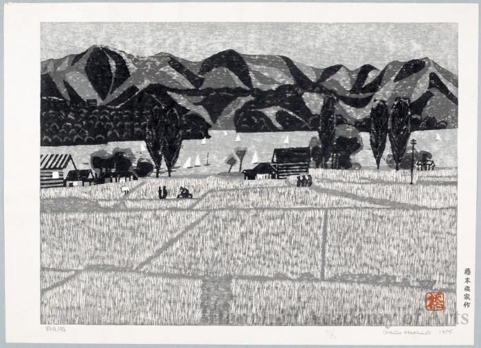
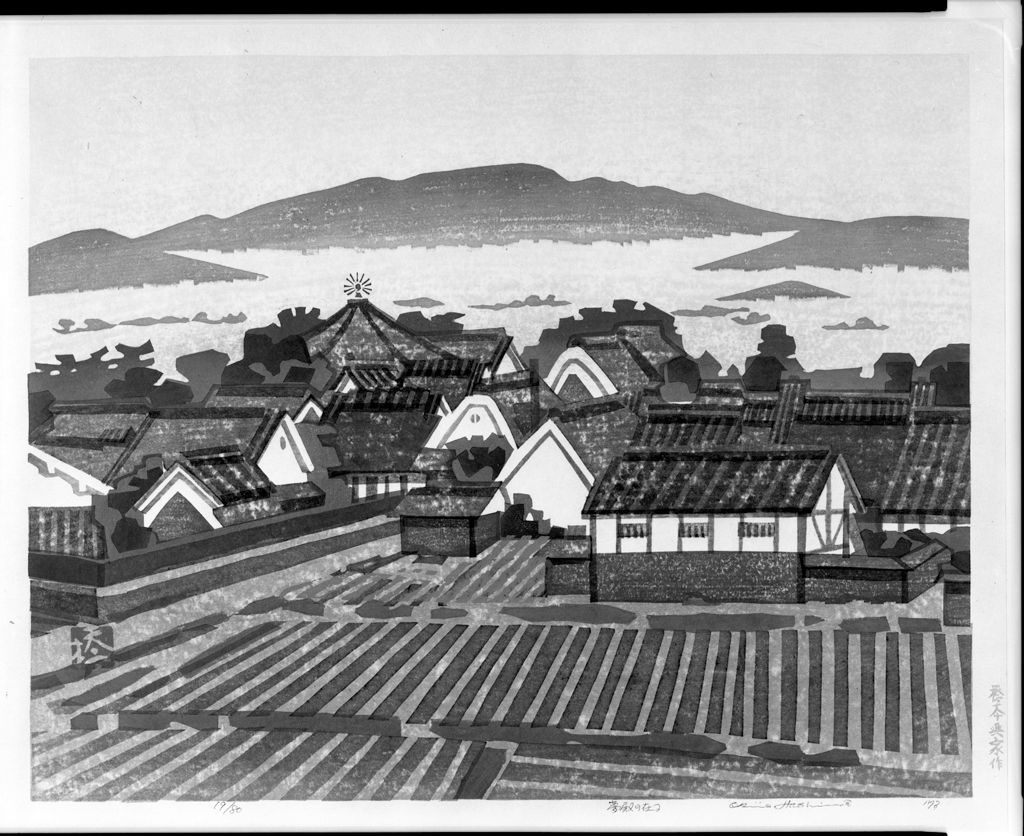
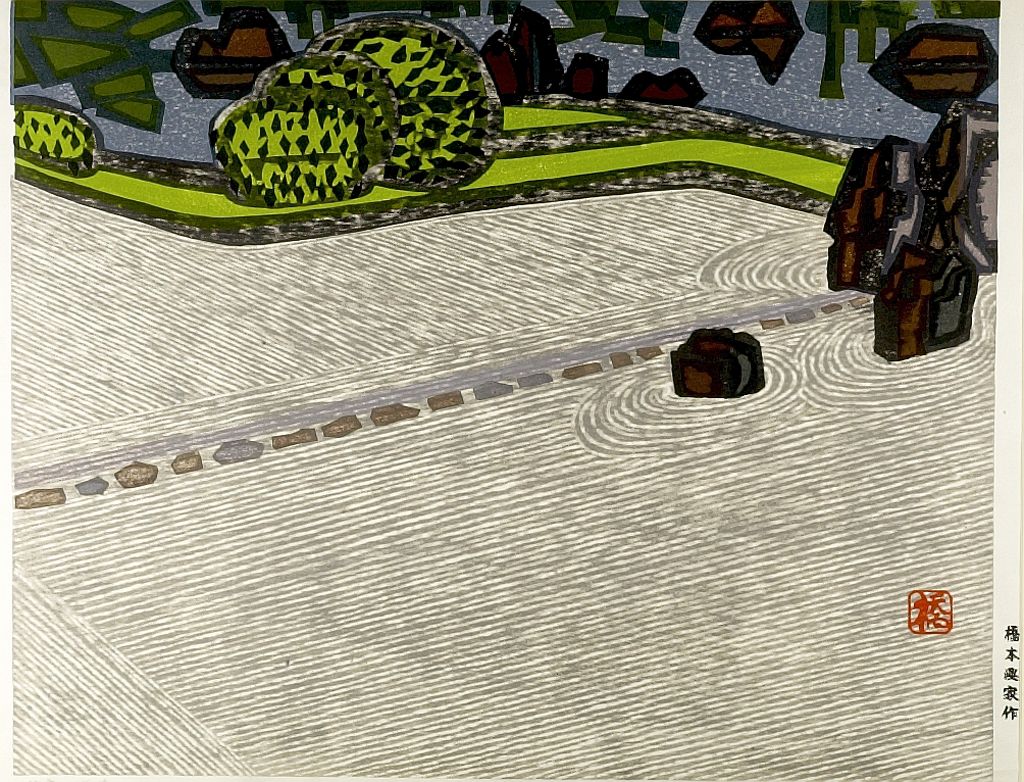

More Mount Fuji Prints
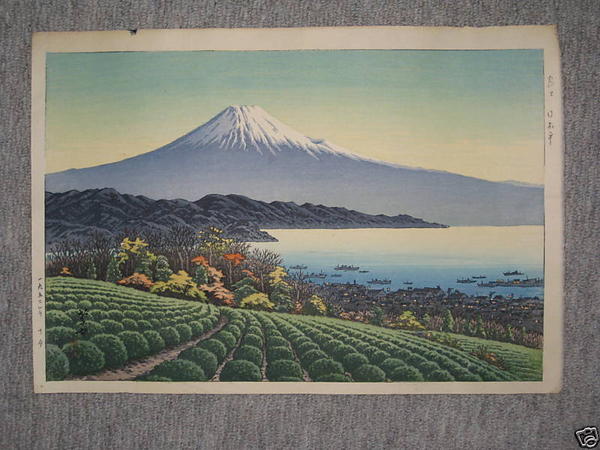
Fuji from tea farm
Woodblock print

Akasaka, Fujikawa, Okazaki, Chiryu, and Narumi, from the series "Famous Places on the Fifty-three Stations of the Tokaido, Five Stations (Tokaido gojusan eki goshuku meisho)"
c. 1830/35
Color woodblock print; oban
![Mount Fuji on a Moonlit Night, Kawai Bridge (Tsukiyo no Fuji [Kawaibashi]), from the series "Selection of Views of the Tokaido (Tokaido fukei senshu)" by Kawase Hasui](https://www.artic.edu/iiif/2/d0960668-1e73-339a-b182-fb995a54bff0/full/843,/0/default.jpg)
Mount Fuji on a Moonlit Night, Kawai Bridge (Tsukiyo no Fuji [Kawaibashi]), from the series "Selection of Views of the Tokaido (Tokaido fukei senshu)"
1947
Color woodblock print; oban

Mt. Fuji in Rain (Ame no Fuji)
n.d.
Color woodblock print
Featured in Collections
Curated cross-cuts that include this print.
Frequently Asked Questions
Mt Fuji seen from Mt Kobotoke was created by Okiie Hashimoto (橋本興家).
Mt Fuji seen from Mt Kobotoke depicts mount fuji.