
Pass to Mt. Fuji
- Medium:
- Mokuhanga (Japanese woodblock)
- Image courtesy of
- Saru Gallery
Description
Rather than confronting Fuji head-on in the manner of Hokusai or Hasui, Hashimoto frames the mountain through the geometry of the approach — likely a road, ridge, or gap in surrounding hills that channels the eye toward the distant cone. This indirect framing reflects his architectural instinct for treating landscape as a sequence of structural planes. The print would use crisp keyblock outlines for the foreground forms and softer bokashi for Fuji itself, pushing the peak into atmospheric distance. Hashimoto carved and printed the blocks himself in keeping with sosaku-hanga principles, and the choice of a 'pass' rather than a panoramic view aligns with his interest in the experience of arriving at a place. While Fuji is less central to his catalogue than to those of Yoshida or Kawase Hasui, his version reads it through the same disciplined compositional vocabulary that governs his temple and castle prints.
More Prints by Okiie Hashimoto

More Mount Fuji Prints
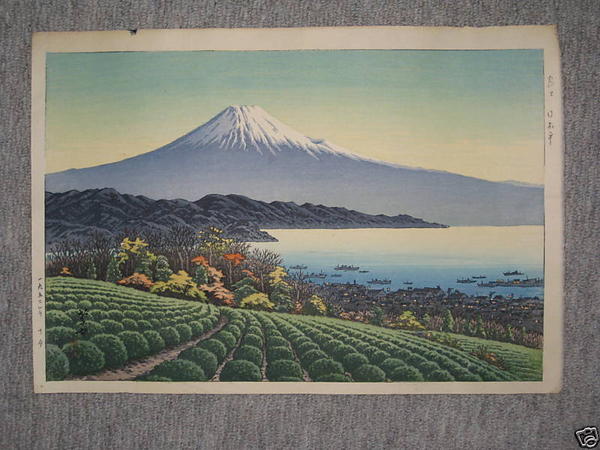
Fuji from tea farm
Woodblock print

Akasaka, Fujikawa, Okazaki, Chiryu, and Narumi, from the series "Famous Places on the Fifty-three Stations of the Tokaido, Five Stations (Tokaido gojusan eki goshuku meisho)"
c. 1830/35
Color woodblock print; oban
![Mount Fuji on a Moonlit Night, Kawai Bridge (Tsukiyo no Fuji [Kawaibashi]), from the series "Selection of Views of the Tokaido (Tokaido fukei senshu)" by Kawase Hasui](https://www.artic.edu/iiif/2/d0960668-1e73-339a-b182-fb995a54bff0/full/843,/0/default.jpg)
Mount Fuji on a Moonlit Night, Kawai Bridge (Tsukiyo no Fuji [Kawaibashi]), from the series "Selection of Views of the Tokaido (Tokaido fukei senshu)"
1947
Color woodblock print; oban

Mt. Fuji in Rain (Ame no Fuji)
n.d.
Color woodblock print
Featured in Collections
Curated cross-cuts that include this print.
Frequently Asked Questions
Pass to Mt. Fuji was created by Okiie Hashimoto (橋本興家).
Pass to Mt. Fuji depicts mount fuji.