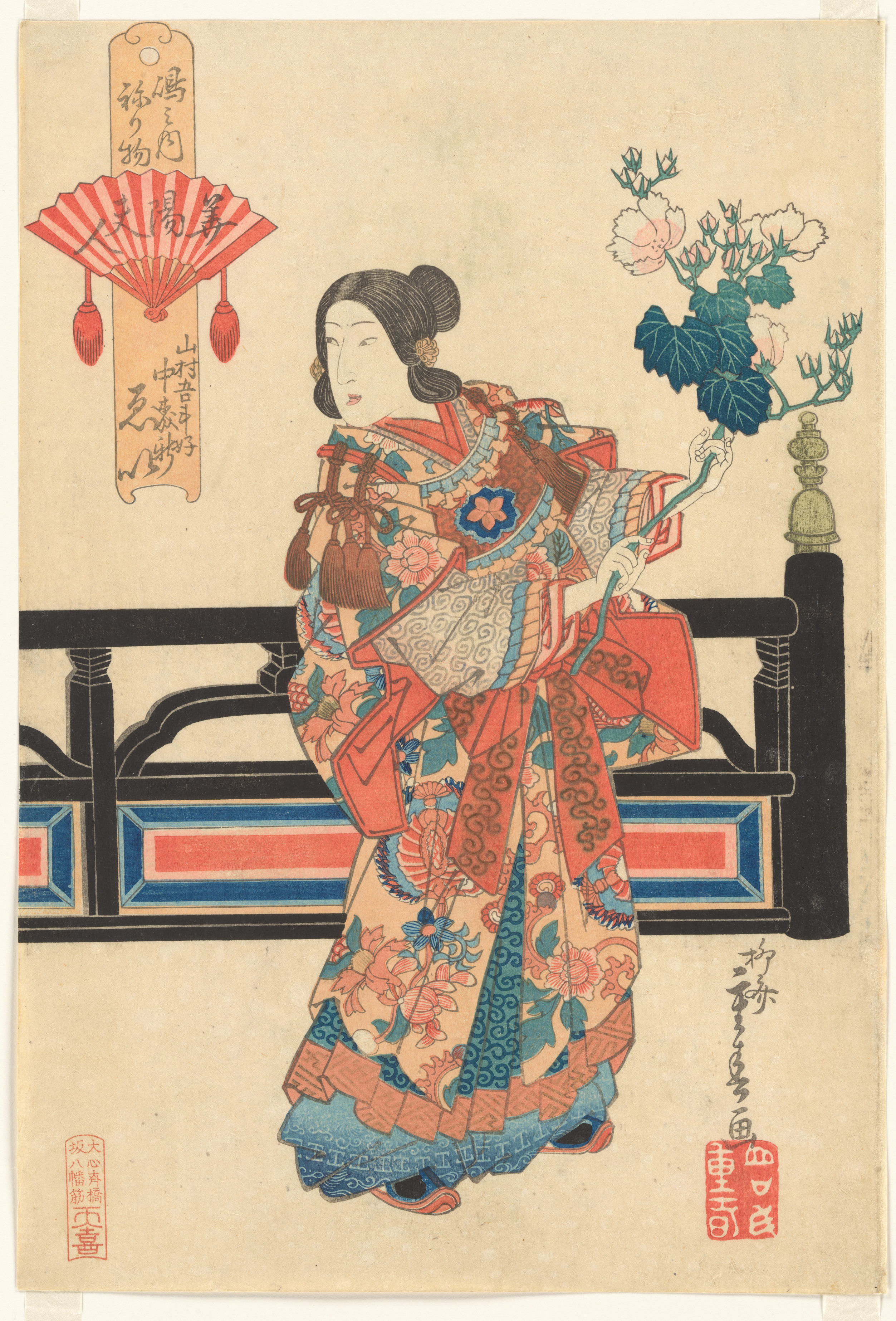
"Ei of the Nakamoriken Brothel, who was a favorite of Yamamura Goto, as Lady Huayang (Kayō Fujin Yamamura Goto gonomi Nakamoriken Ei)," from the series Costume Parade of the Shimanouchi District in Osaka (Naniwa Shimanouchi nerimono)
- Date:
- 1836
- Medium:
- Right sheet of a diptych of woodblock prints (nishiki-e); ink and color on paper; vertical ōban
- Source:
- Metropolitan Museum of Art
Description
This 1836 print by Ryūsai Shigeharu, held by the Metropolitan Museum of Art (accession 2020.305), is the right sheet of a diptych depicting Ei of the Nakamoriken brothel — a favorite of the actor Yamamura Goto — costumed as the Chinese imperial concubine Lady Huayang (Kayō Fujin) for the annual costume parade of Osaka's Shimanouchi pleasure quarter. The Naniwa Shimanouchi nerimono series was a multi-artist project documenting the annual nerimono procession in which the courtesans of the Shimanouchi district paraded through the streets in elaborate themed costumes, often impersonating historical or theatrical figures, and the 1836 series captured one of the major late-Tenpō stagings of this event. The print measures the standard vertical ōban format as a woodblock print in ink and color on paper (nishiki-e), and the Met's holding is part of a 2020 acquisition that brought a focused group of Shigeharu Shimanouchi prints into the museum's collection. The series belongs to the small but important sub-genre of Osaka kamigata-e that documented the pleasure-quarter culture alongside the theatrical stage, and Shigeharu's contributions to the project capture the cross-traffic between the actor and courtesan worlds that defined Osaka popular culture in the 1830s.
More Prints by Ryūsai Shigeharu
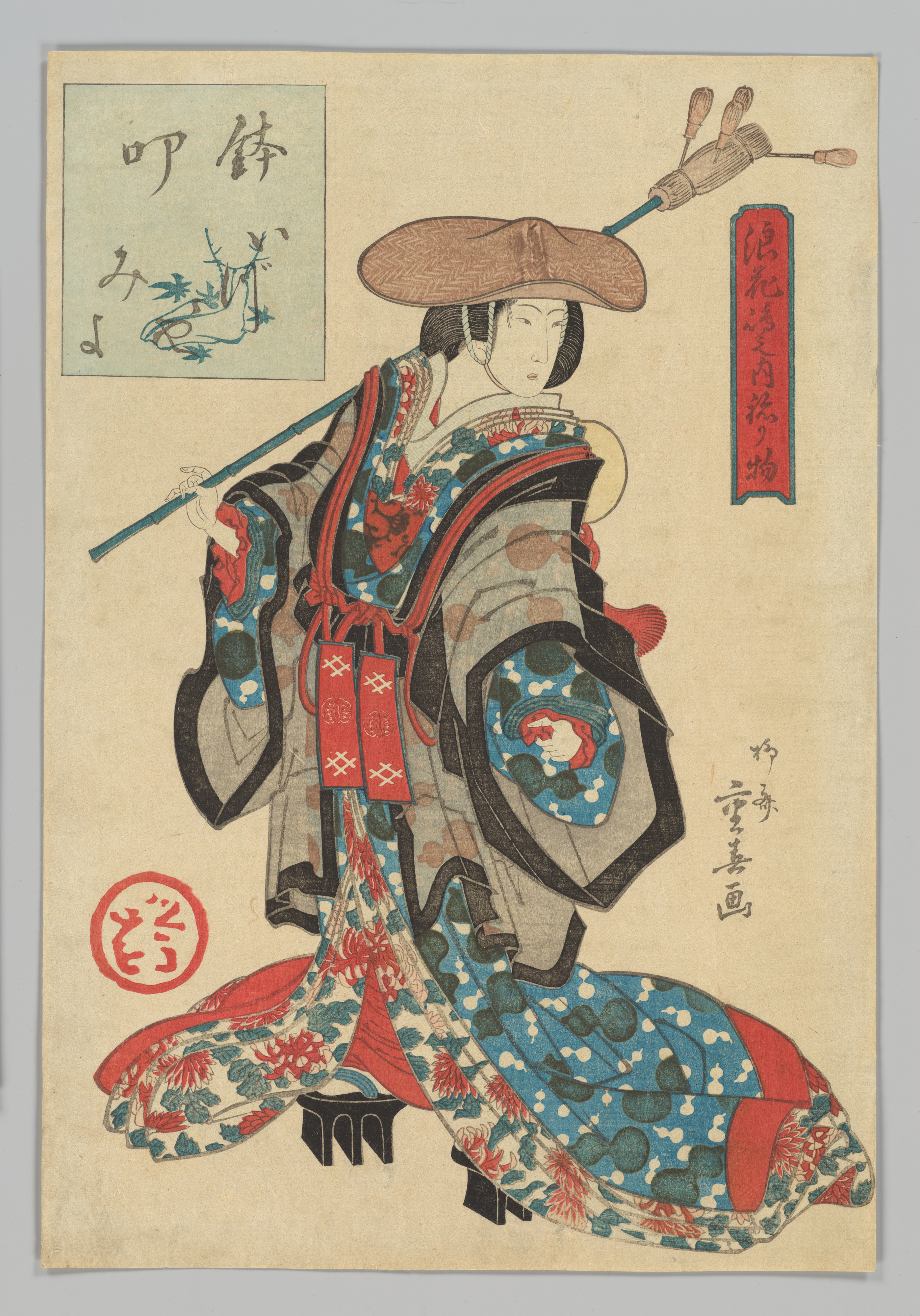
The Courtesan Miyo of the Izutsuya Brothel as a Tea Whisk Vendor, from the series Costume Parade of the Shimanouchi District in Osaka (Naniwa Shimanouchi nerimono, Hachitataki Izutsuya Miyo)
1828, sixth month
Woodblock print (nishiki-e); ink and color on paper
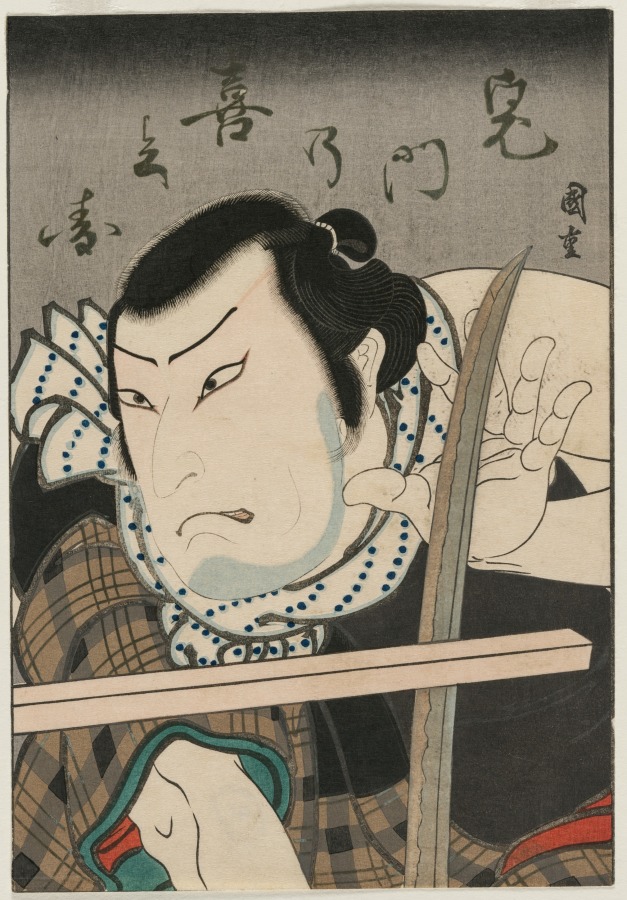
Actor as Kimon no Kihei
before 1826
Color woodblock print
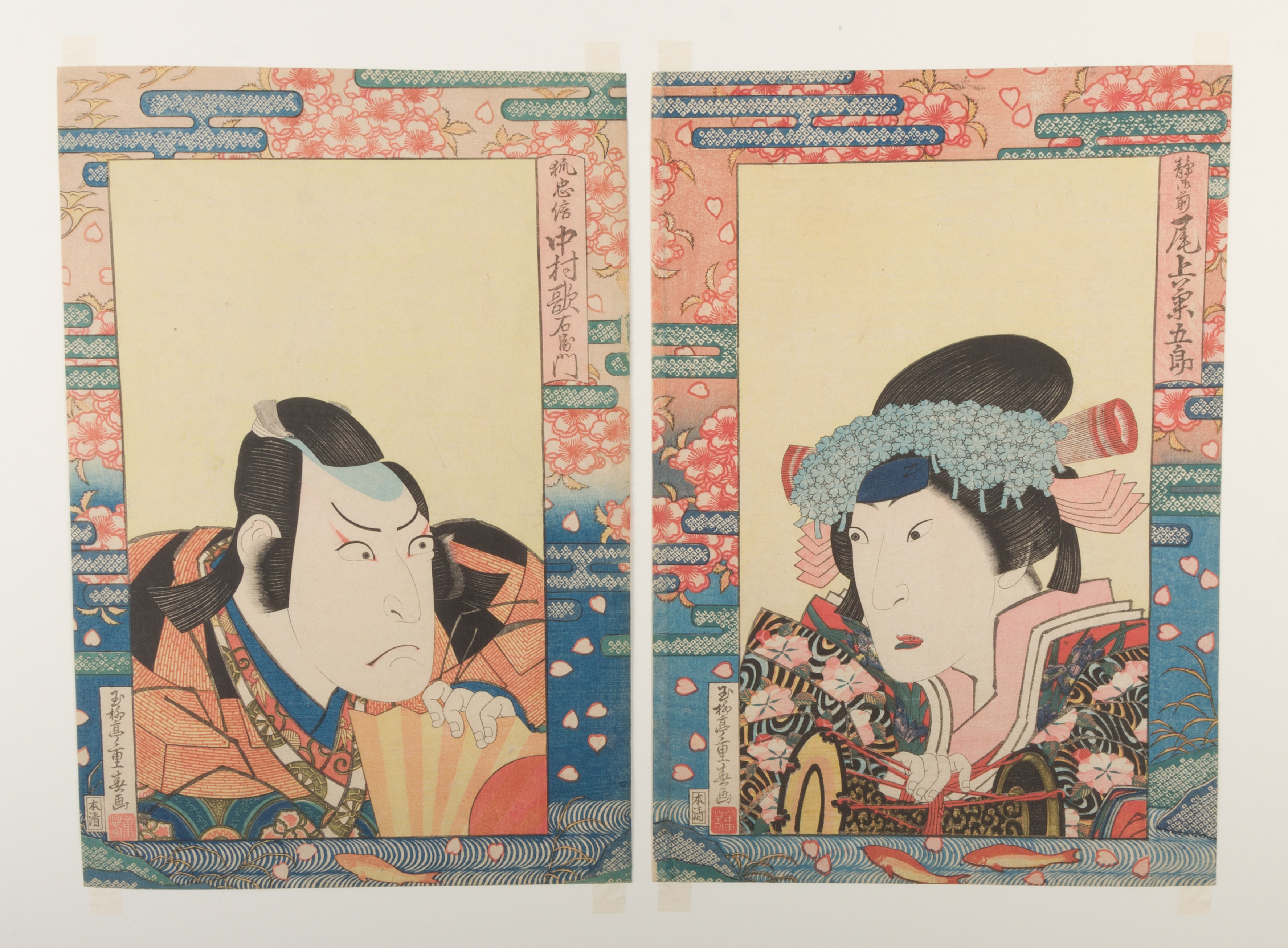
Kabuki Actors Onoe Kikugorō III as Shizuka Gozen and Nakamura Utaemon III as Kitsune Tadanobu, in the play Yoshitsune senbon zakura (The Thousand Cherry Trees of Yoshitsune)
1830
Diptych of woodblock prints (nishiki-e); ink and color on paper; vertical ōban
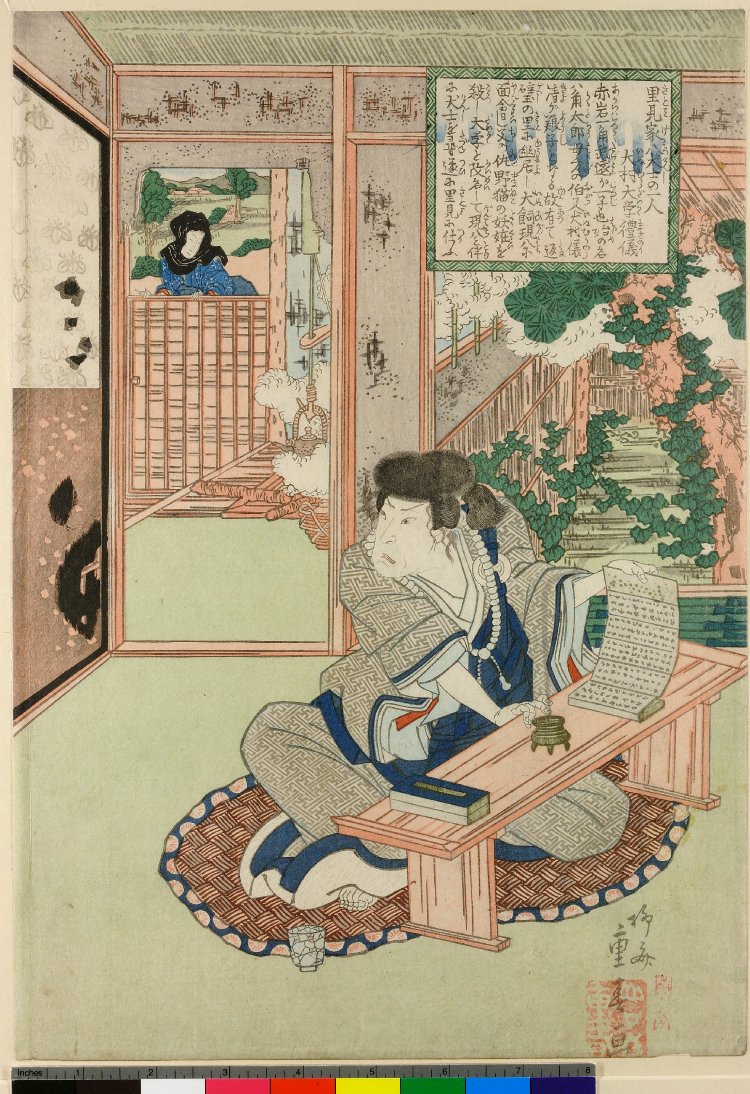
Satomi ke Hakkenshi no hitori (One of the Eight Heroes of the Satomi Clan: Inumura Daikaku Surprised by a Female in His Hermitage)
c. 1830s
Color woodblock print
More Mount Fuji Prints
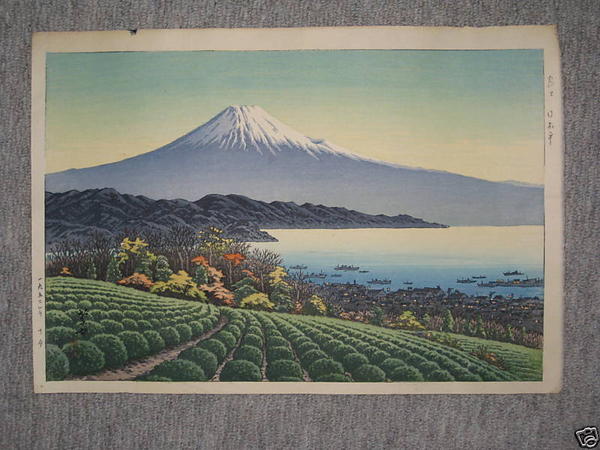
Fuji from tea farm
Woodblock print

Akasaka, Fujikawa, Okazaki, Chiryu, and Narumi, from the series "Famous Places on the Fifty-three Stations of the Tokaido, Five Stations (Tokaido gojusan eki goshuku meisho)"
c. 1830/35
Color woodblock print; oban
![Mount Fuji on a Moonlit Night, Kawai Bridge (Tsukiyo no Fuji [Kawaibashi]), from the series "Selection of Views of the Tokaido (Tokaido fukei senshu)" by Kawase Hasui](https://www.artic.edu/iiif/2/d0960668-1e73-339a-b182-fb995a54bff0/full/843,/0/default.jpg)
Mount Fuji on a Moonlit Night, Kawai Bridge (Tsukiyo no Fuji [Kawaibashi]), from the series "Selection of Views of the Tokaido (Tokaido fukei senshu)"
1947
Color woodblock print; oban

Mt. Fuji in Rain (Ame no Fuji)
n.d.
Color woodblock print
Featured in Collections
Curated cross-cuts that include this print.
Frequently Asked Questions
"Ei of the Nakamoriken Brothel, who was a favorite of Yamamura Goto, as Lady Huayang (Kayō Fujin Yamamura Goto gonomi Nakamoriken Ei)," from the series Costume Parade of the Shimanouchi District in Osaka (Naniwa Shimanouchi nerimono) was created by Ryūsai Shigeharu (柳斎重春) in 1836.
"Ei of the Nakamoriken Brothel, who was a favorite of Yamamura Goto, as Lady Huayang (Kayō Fujin Yamamura Goto gonomi Nakamoriken Ei)," from the series Costume Parade of the Shimanouchi District in Osaka (Naniwa Shimanouchi nerimono) depicts mount fuji.