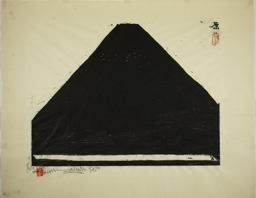
Hara: A Line at the Foot of Mt. Fuji, Munakata's Tokaido Road
- Medium:
- Woodblock print
- Source:
- Art Institute of Chicago
- Image courtesy of
- Art Institute of Chicago
Description
Station thirteen on the Tokaido highway, Hara offered travelers one of the most celebrated frontal views of Mount Fuji, a motif Hiroshige had made canonical in his own Tokaido series. Munakata's interpretation departs radically from that tradition: where Hiroshige's Hara is serene and atmospheric, Munakata's Tokaido prints are compacted, linear, and charged with movement. The subtitle's reference to a line at the foot of Fuji likely indicates a procession or continuous horizontal element across the composition—a characteristic device that Munakata used to generate rhythmic tension. His Fuji, if rendered at all, would appear as a stark mass defined by aggressive gouge lines rather than the delicate bokashi gradations of ukiyo-e landscape printing. The series reinterprets meisho-e as a vehicle for sosaku-hanga expression.
More Prints by Shiko Munakata
More Landscapes Prints

Lake Kugushi in Wakasa Province (Wakasa Kugushiko), from the series Souvenirs of Travel I (Tabi miyage dai isshu)"
Wakasa Kugushiko
1920
Color woodblock print; oban
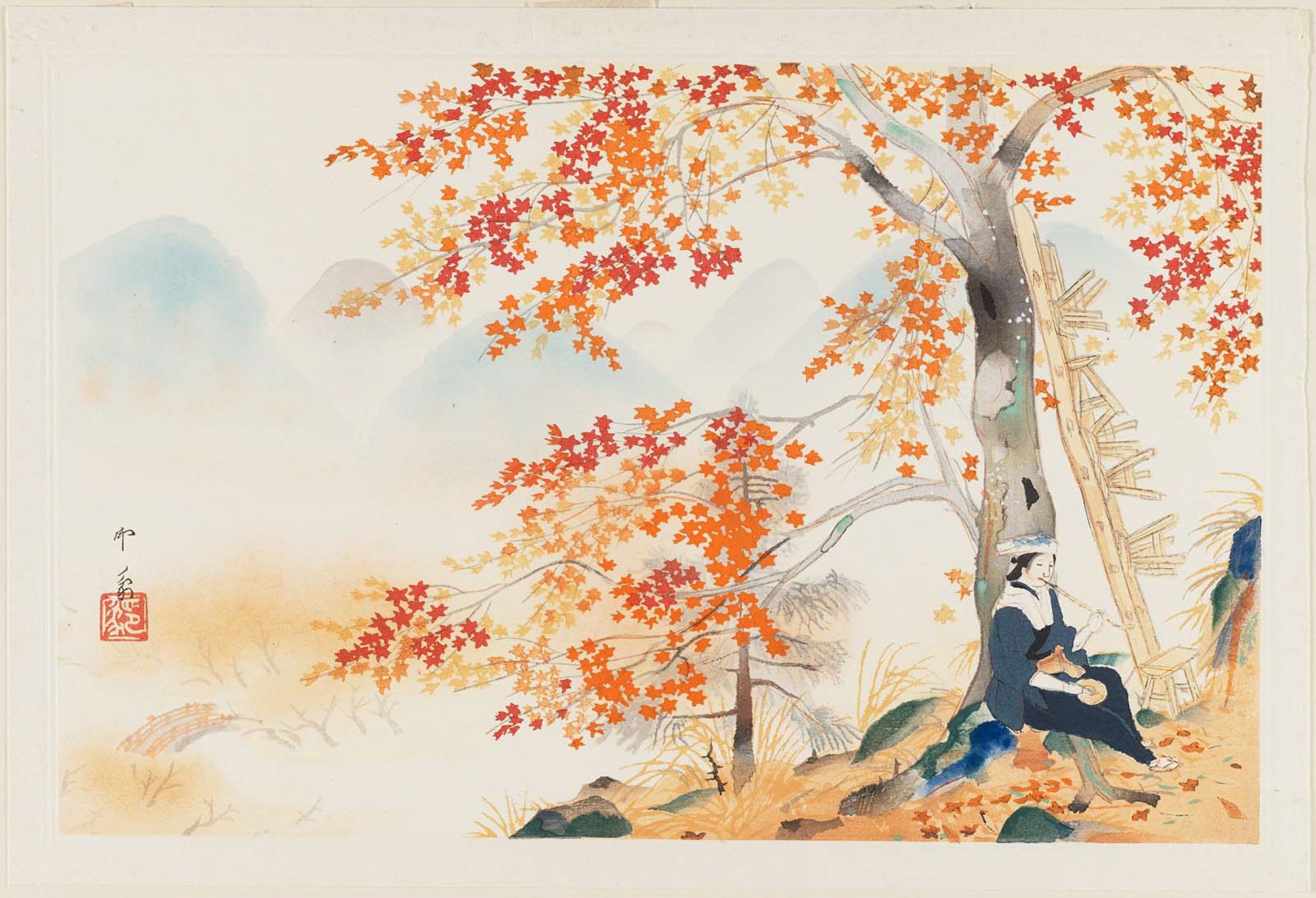
Autumn Maple Leaves at Takao, from the album Eight Views of Kyoto (Kyôto hakkei)
Woodblock print

The Beach at Kaiganji in Sanuki Province (Sanuki Kaiganji no hama), from the series "Collection of Views of Japan II, Kansai Edition (Nihon fukei shu II Kansai hen)"
1934
Color woodblock print; oban

Tea Kettle, section of a sheet from the series "Mirror of Stone Rubbings of Views of the Provinces" (Kohon meihitsu ishizuri kagami)
n.d.
Woodblock print; ishizuri-e, section of harimaze sheet
Featured in Collections
Curated cross-cuts that include this print.
Frequently Asked Questions
Hara: A Line at the Foot of Mt. Fuji, Munakata's Tokaido Road was created by Shiko Munakata (棟方志功).
Hara: A Line at the Foot of Mt. Fuji, Munakata's Tokaido Road depicts landscapes, mount fuji, and travel scenes.