Harvest
by Shōda Kōhō
- Date:
- circa 1930s
- Medium:
- Color woodblock print
- Source:
- Japanese Art Open Database
Description
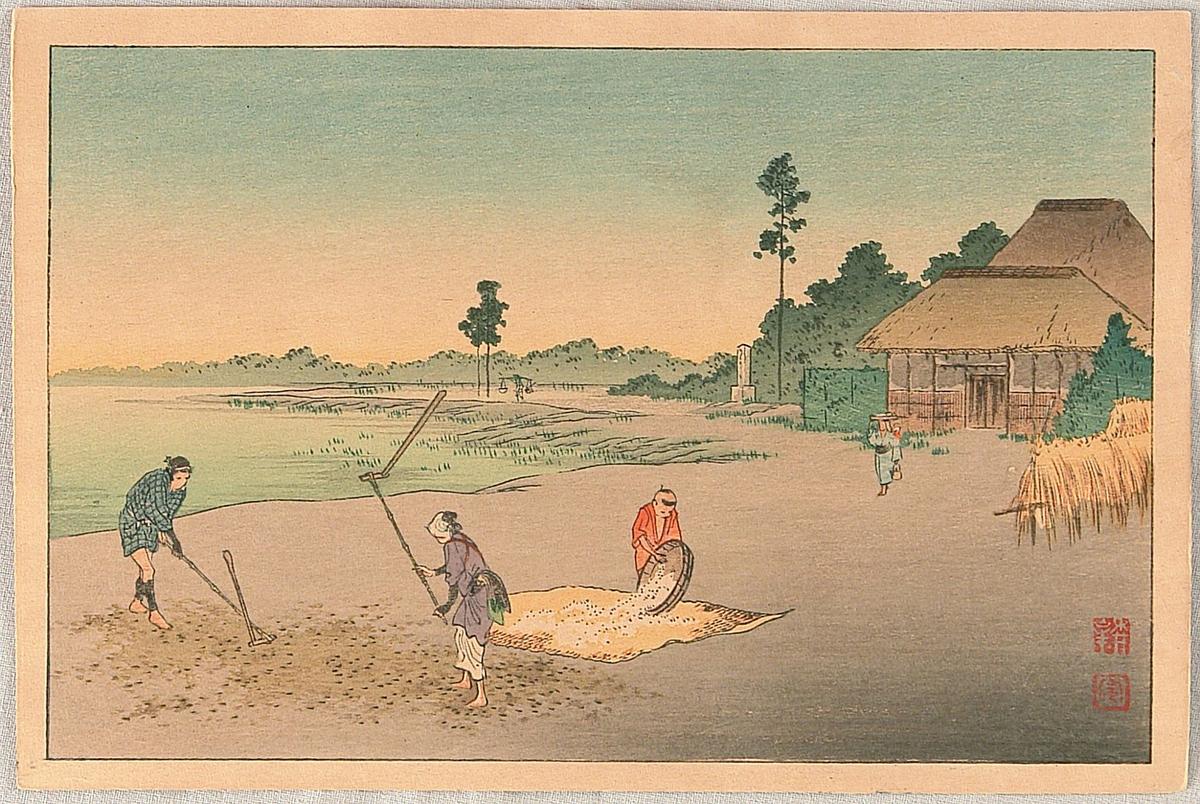
Harvest, published around 1930 by the Hasegawa publisher in Tokyo, is among the more expansive of Shoda Koho's late shin-hanga landscape designs, a print in which the firm's atmospheric mode is applied to a panoramic rural subject from the autumn agricultural calendar. The composition opens across a broad field of golden rice stalks under harvest, with a few small figures stooped at their work in the middle ground and a distant line of low hills closing the horizon. Koho organizes the sheet with a horizontal calm, the receding rows of cut and standing rice carrying the eye into depth while the warm prevailing tones of the field anchor the composition. The palette is more openly chromatic than in his earlier nocturnes, dominated by ochre, warm gold, and dusky lavender, with the figures providing small dark accents within the prevailing autumn light. The Hasegawa carvers articulated the rice stalks and the figures' silhouettes with precise keyblock work, while the printers used overlaid bokashi gradations to model the sky and distant hills, layering washes that pass from pale apricot at the horizon to a deeper blue overhead, a printing effect for which the studio was widely admired. Issued in a larger format than Koho's earlier chuban nocturnes, the design reflects the broader market for shin-hanga landscapes in the late Taisho and early Showa years, when Hasegawa expanded its export catalogue to compete with the success of Watanabe Shozaburo's parallel productions. The impression documented in the Japanese Art Open Database (https://ukiyo-e.org/image/jaodb/Koho_Shoda-No_Series-Harvest-00042345-100712-F12) preserves the saturated yet airy tonal range and the crisp figure work that distinguish strong impressions of this generously observed harvest scene, one of Koho's most fully realised rural compositions.