Lotus
by Shōda Kōhō
- Date:
- circa 1910-1930s
- Medium:
- Color woodblock print; tanzaku
- Source:
- Japanese Art Open Database
Description
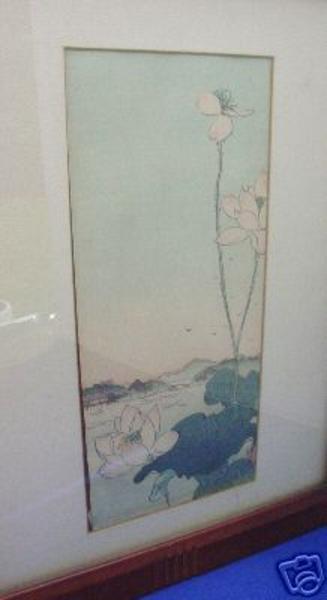
Lotus, issued around 1920 by the Hasegawa publisher in Tokyo, is among the most refined of Shoda Koho's shin-hanga kacho-e designs, a sheet in which the firm's atmospheric sensibility is condensed into a single botanical study with deep classical resonance. A pair of lotus blossoms is shown rising from broad rounded leaves, the flowers caught in the moment of opening so that the petals retain both the fullness of the bud and the lift of full bloom. Koho organizes the composition around the vertical of the stems and the horizontal sweep of the leaves, allowing the unprinted paper to do much of the descriptive work for the lightest petals while the deeper interior of each blossom is built up in soft graduated colour. The palette is held to a tight range of muted pink, ivory, dusky green, and pond-grey, with no bright accent disturbing the meditative mood. The Hasegawa carvers translated the painter's brush into a delicate keyblock for the petal edges and leaf veining, while the printers used overlaid bokashi gradations to model the petal interiors and the recessive background, achieving the soft tonal transitions that the studio became known for. The design extends the long Japanese tradition of lotus subjects, with their deep Buddhist associations, into the new shin-hanga botanical idiom that Hasegawa cultivated for both export and domestic audiences. Issued in the small chuban format characteristic of the firm's catalogue, the print was marketed to foreign collectors and to a growing domestic audience attentive to the shin-hanga revival of classical Japanese subjects. The impression documented in the Japanese Art Open Database (https://ukiyo-e.org/image/jaodb/Koho_Shoda-No_Series-Lotus-00041838-090120-F06) preserves the subtle petal gradations and crisp leaf armature that distinguish strong impressions of this contemplative botanical study.