
Dawn at Takegawa
- Source:
- ukiyo-e.org
Description
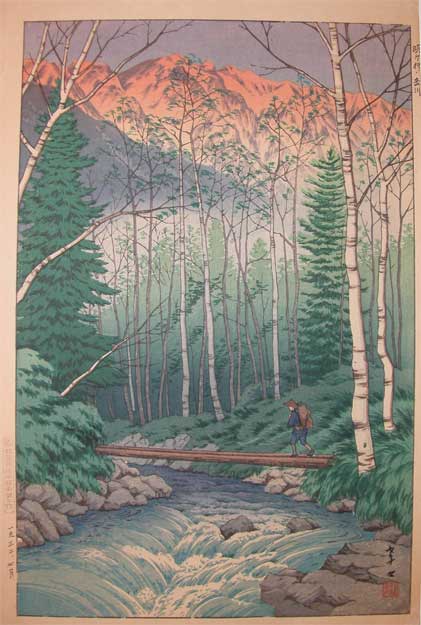
Dawn at Takegawa is a Japanese woodblock print by Takashi Henmi that captures the first light of morning along the Takegawa, a small river whose name appears in the regional landscape repertoire of twentieth-century Japanese printmakers. The scene is built around a low horizon, with quiet water in the foreground reflecting the pale, graduated sky that Henmi achieves through careful bokashi shading, the hand-wiped gradient long associated with traditional Japanese woodblock technique. Banks of reeds, a sparse cluster of trees, and the distant silhouette of buildings or hills emerge gradually from the cool dawn haze, giving the composition an unhurried, observational quality rather than a dramatic one. Working in the sosaku-hanga tradition, Takashi Henmi designed, carved, and printed his blocks himself, in keeping with the movement's emphasis on the artist as the single creative voice behind a Japanese woodblock. That self-printing approach is visible in the slightly irregular registration and the deliberate use of woodgrain as a tonal element, lending the water and sky a quiet vibration that distinguishes sosaku-hanga from the smoother, more commercially polished shin-hanga landscapes of the same period. Subjects like Takegawa fit within a broader sosaku-hanga preference for ordinary, regional places observed at transitional times of day, including dawn, dusk, and fog, where atmosphere matters more than landmark recognition. The print is recorded through ukiyo-e.org's database, drawing on dealer and collection sources that have circulated impressions of Henmi's quieter river views, and it stands as a representative example of how mid-century Japanese woodblock artists used modest local scenery to extend the lyrical landscape tradition.
More Prints by Henmi Takashi



Featured in Collections
Curated cross-cuts that include this print.
Frequently Asked Questions
Dawn at Takegawa was created by Henmi Takashi (逸見享).