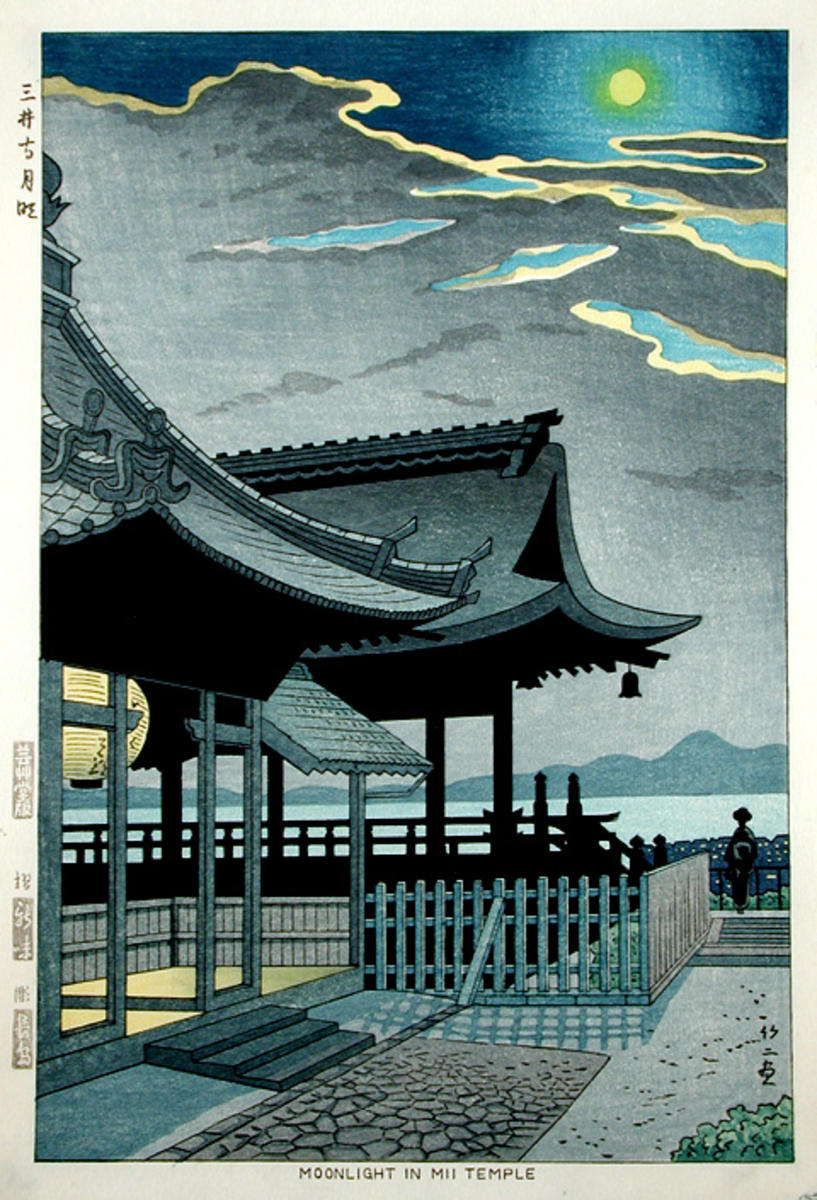
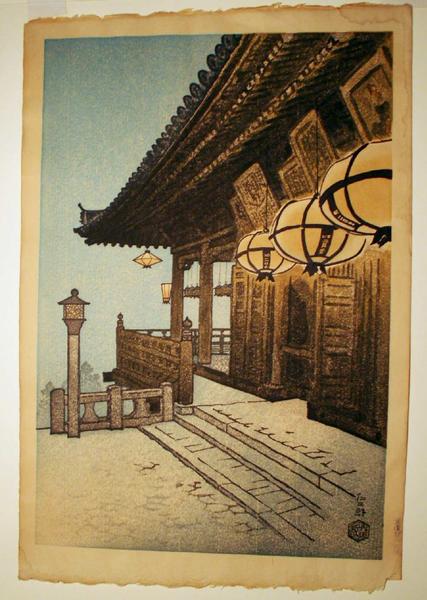
Moonlight in Mii Temple
by Takeji Asano
- Date:
- 1952
- Medium:
- Woodblock print
- Format:
- Oban
- Publisher:
- Unsodo
- Source:
- Ukiyo-e.org (via Artelino)
Description
Moonlight in Mii Temple, dated 1952, presents the Onjoji Temple on the eastern shore of Lake Biwa — commonly called Mii-dera for the spring whose water was used in the purification of three successive emperors — in the exceptional light of moonlit night. The temple's famous bell (one of the three great bells of Japan, renowned for its tone) and its position overlooking Lake Biwa made it among the most evocative sacred sites associated with moonlight in the classical Japanese aesthetic tradition. Asano's nocturnal rendering captures the temple in the condition that classical poets and artists had celebrated for centuries.
More Prints by Takeji Asano


More Temples & Shrines Prints
Fushimi Inari Temple
伏見稲荷
Woodblock print

The Compound of the Tenman Shrine at Kameido in the Snow (Kameido Tenmangu keidai no yuki), from the series "Famous Places in the Eastern Capital (Toto meisho)"
c. 1832/38
Color woodblock print; oban
Temple with lanterns
Woodblock print

A Section of the Byodo Temple at Uji (Uji Byodoin no ichibu), from the series "Souvenirs of Travel, Second Series (Tabi miyage dai nishu)"
Uji Byodoin no ichibu
1921
Color woodblock print; oban
Featured in Collections
Curated cross-cuts that include this print.
Frequently Asked Questions
Moonlight in Mii Temple was created by Takeji Asano (浅野竹二) in 1952.
Moonlight in Mii Temple uses Bokashi, Nishiki-e, and Moku-hanga, on woodblock print.
Moonlight in Mii Temple was published by Unsodo (1952).
Moonlight in Mii Temple depicts temples & shrines, moonlight, and night scenes.