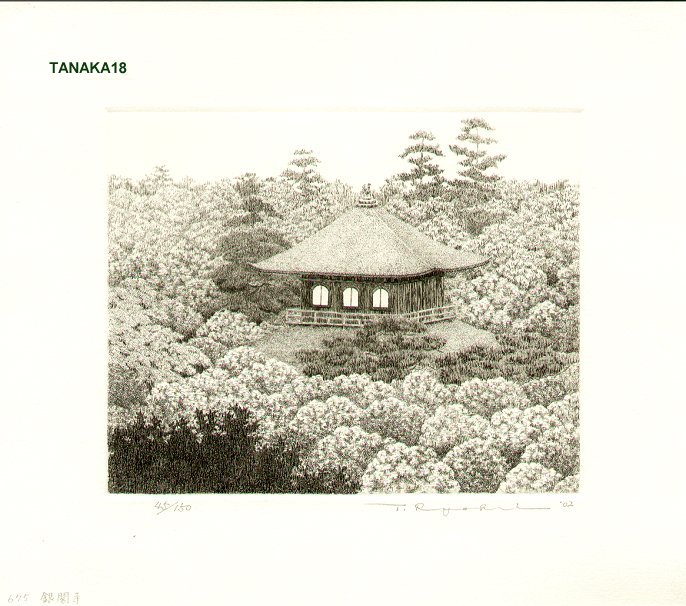
Ginkakuji (Silver Pavilion)
- Medium:
- Woodblock print
- Image courtesy of
- Asian Collection Internet Auction
Description
Ginkakuji, the fifteenth-century Zen temple complex in Kyoto's Higashiyama district, presents Tanaka with architecture of studied refinement rather than rural vernacular construction. The Silver Pavilion itself — a two-story structure on the edge of a garden pond — offers strong vertical and horizontal geometry against a hillside backdrop of dense vegetation. In etching, the contrast between the pavilion's precise joinery and the organic texture of surrounding moss, raked sand, and maples would require careful tonal management through aquatint or fine hatching. Tanaka likely depicted the structure in its garden context, using reflected water to introduce soft tone beneath the architectural forms. The print situates his draftsmanship within a landscape tradition concerned with famous places (meisho) while maintaining the quiet, unpopulated quality consistent throughout his work.
More Prints by Tanaka Ryohei


More Temples & Shrines Prints
Fushimi Inari Temple
伏見稲荷
Woodblock print

The Compound of the Tenman Shrine at Kameido in the Snow (Kameido Tenmangu keidai no yuki), from the series "Famous Places in the Eastern Capital (Toto meisho)"
c. 1832/38
Color woodblock print; oban
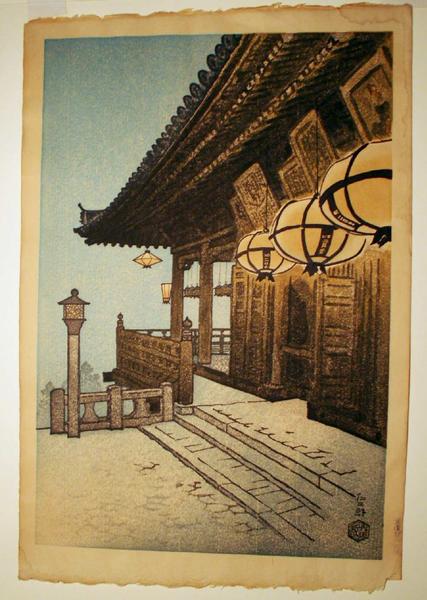
Temple with lanterns
Woodblock print

A Section of the Byodo Temple at Uji (Uji Byodoin no ichibu), from the series "Souvenirs of Travel, Second Series (Tabi miyage dai nishu)"
Uji Byodoin no ichibu
1921
Color woodblock print; oban
Featured in Collections
Curated cross-cuts that include this print.
Frequently Asked Questions
Ginkakuji (Silver Pavilion) was created by Tanaka Ryohei (田中良平).
Ginkakuji (Silver Pavilion) uses Etching, on woodblock print.
Ginkakuji (Silver Pavilion) depicts temples & shrines, architecture, and animals.