
Arashiyama Kyoto
- Medium:
- Mokuhanga (Japanese woodblock)
- Image courtesy of
- Saru Gallery
Description
Arashiyama, the western edge of Kyoto where the Hozu River becomes the Katsura, is a district Tokuriki returned to repeatedly across his career. The composition typically centers Togetsukyo, the Moon-Crossing Bridge, with the wooded slopes of Mount Arashi rising behind. The river is rendered through bokashi gradation, transitioning from a deeper hue at the banks to lighter water in the channel, while the hillside foliage is built up from layered blocks that suggest mixed deciduous and coniferous growth without descriptive line. Born and based in Kyoto, Tokuriki documented the city's seasonal life across thousands of prints. Arashiyama's combination of natural setting and historical landmarks—the bridge originally dates to 836, and the Tenryu-ji temple precinct sits nearby—made it a recurring meisho-e subject, and he worked it within both shin-hanga and sosaku-hanga frameworks during different phases of his output.
More Prints by Tomikichiro Tokuriki
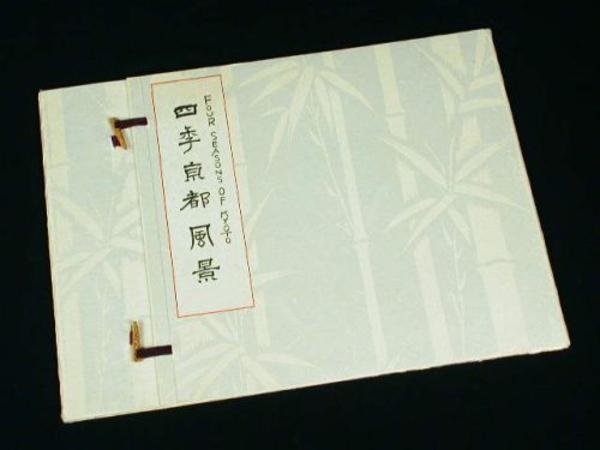
Heian Shrine in the Spring
Woodblock print
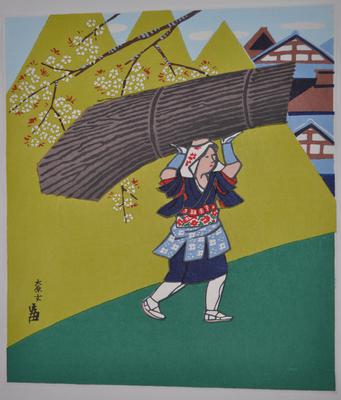
An Oharame Girl Carrying Firewood on Her Head
20th century
Woodblock print, ink and color on paper

April (Arashiyama Park, a Famous Scenic Resort)
四月 (嵐山)
second half 20th century
Woodblock print, ink and color on paper

June (Rainy Scene of the Sen-ke, Japanese Tea Ceremony Founder's House)
六月 (千家雨景)
second half 20th century
Woodblock print, ink and color on paper
Featured in Collections
Curated cross-cuts that include this print.
Frequently Asked Questions
Arashiyama Kyoto was created by Tomikichiro Tokuriki (徳力富吉郎).