
Flowers
- Medium:
- Mokuhanga (Japanese woodblock)
- Image courtesy of
- Saru Gallery
Description
Without a more specific title, this print belongs to Tokuriki's kacho-e (bird-and-flower picture) practice, the genre concerned with botanical and ornithological subjects. Kacho-e was codified during the Edo period and continued in the shin-hanga revival, with artists such as Ohara Koson, Imao Keinen, and Watanabe Seitei establishing twentieth-century conventions. Tokuriki produced floral compositions across his career, frequently using a close-cropped framing in which a single branch or cluster fills the sheet against a flat or graded ground. Technical choices typical to the form include flat color blocks set against bokashi backgrounds, selective baren burnishing to achieve crisp leaf edges, and occasional karazuri (blind embossing) to emphasize petal contour. Tokuriki's kacho-e are less widely circulated than his Kyoto and Fuji landscapes but reflect the same emphasis on seasonal observation that runs through his broader oeuvre, and they sit alongside his meisho-e work as a parallel decorative line.
More Prints by Tomikichiro Tokuriki
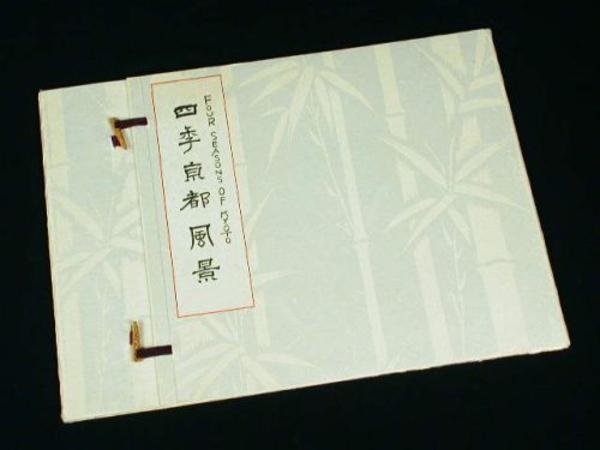
Heian Shrine in the Spring
Woodblock print
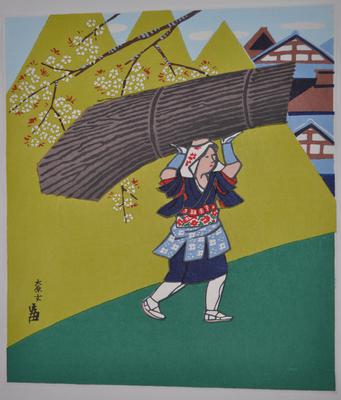
An Oharame Girl Carrying Firewood on Her Head
20th century
Woodblock print, ink and color on paper

April (Arashiyama Park, a Famous Scenic Resort)
四月 (嵐山)
second half 20th century
Woodblock print, ink and color on paper

June (Rainy Scene of the Sen-ke, Japanese Tea Ceremony Founder's House)
六月 (千家雨景)
second half 20th century
Woodblock print, ink and color on paper
Featured in Collections
Curated cross-cuts that include this print.
Frequently Asked Questions
Flowers was created by Tomikichiro Tokuriki (徳力富吉郎).