
Katsura Imperial villa
- Medium:
- Mokuhanga (Japanese woodblock)
- Image courtesy of
- Saru Gallery
Description
Katsura Rikyu, the seventeenth-century imperial retreat in western Kyoto, is known for its shoin-style residence, teahouses, and stroll garden organized around a central pond. Tokuriki's print likely depicts one of the canonical views: the Old Shoin's stepped roofline reflected in the pond, the moon-viewing platform projecting over the water, or one of the four teahouses set among the garden's careful plantings. The architecture's restrained geometry—white shoji, dark timber, and tile—would be rendered in the spare palette characteristic of Tokuriki's more contemplative compositions, reserving stronger color for foliage and water. Katsura's status as a touchstone of Japanese architectural modernism, championed by Bruno Taut and later by Kenzo Tange, made it an enduring subject for postwar print artists, and Tokuriki's treatment situates the villa within the tradition of Kyoto landmarks that defines his career-long work.
More Prints by Tomikichiro Tokuriki
Heian Shrine in the Spring
Woodblock print
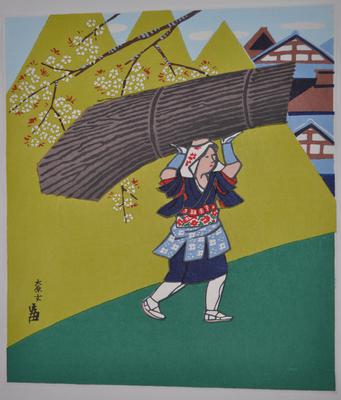
An Oharame Girl Carrying Firewood on Her Head
20th century
Woodblock print, ink and color on paper

April (Arashiyama Park, a Famous Scenic Resort)
四月 (嵐山)
second half 20th century
Woodblock print, ink and color on paper

June (Rainy Scene of the Sen-ke, Japanese Tea Ceremony Founder's House)
六月 (千家雨景)
second half 20th century
Woodblock print, ink and color on paper
Featured in Collections
Curated cross-cuts that include this print.
Frequently Asked Questions
Katsura Imperial villa was created by Tomikichiro Tokuriki (徳力富吉郎).