
Peony
- Medium:
- Mokuhanga (Japanese woodblock)
- Image courtesy of
- Saru Gallery
Description
The peony, or botan, is a foundational subject in Japanese kacho-e, associated with early summer and carrying long-standing connections to Chinese painting traditions imported into Japanese print design. Tokuriki's treatment likely concentrates on a single open bloom with one or two buds, set against a plain or lightly washed background that lets the flower's mass and color dominate. The technical demands of a peony print are considerable: the layered, ruffled petals require multiple registered impressions and careful bokashi to shade each petal edge from saturated color to a pale center. The keyblock provides the leaf veining and the stem's woody texture in a controlled black line. Within Tokuriki's catalogue, kacho-e prints like this one sit alongside the Kyoto temple scenes and Mount Fuji series for which he is widely known, and they show his continuity with the older Edo-period mokuhanga repertoire even as he worked across both shin-hanga and sosaku-hanga modes during the twentieth century.
More Prints by Tomikichiro Tokuriki
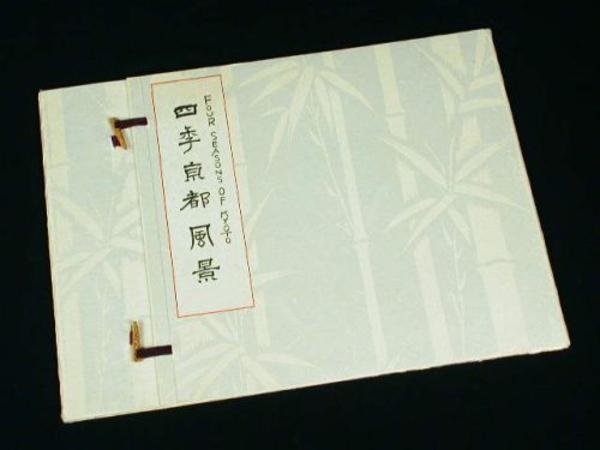
Heian Shrine in the Spring
Woodblock print
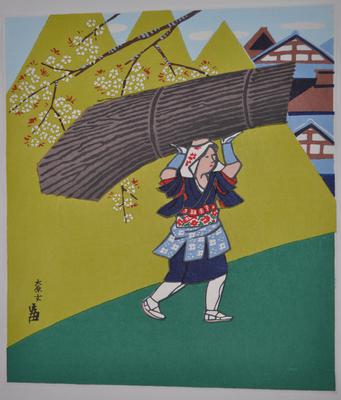
An Oharame Girl Carrying Firewood on Her Head
20th century
Woodblock print, ink and color on paper

April (Arashiyama Park, a Famous Scenic Resort)
四月 (嵐山)
second half 20th century
Woodblock print, ink and color on paper

June (Rainy Scene of the Sen-ke, Japanese Tea Ceremony Founder's House)
六月 (千家雨景)
second half 20th century
Woodblock print, ink and color on paper
More Birds & Flowers Prints
Featured in Collections
Curated cross-cuts that include this print.
Frequently Asked Questions
Peony was created by Tomikichiro Tokuriki (徳力富吉郎).
Peony depicts birds & flowers.