
Roses
- Medium:
- Mokuhanga (Japanese woodblock)
- Image courtesy of
- Saru Gallery
Description
Roses sits within Tokuriki's kacho-e (bird-and-flower) practice, although the choice of a Western flower departs from the irises, plums, and chrysanthemums that dominate the older Edo-period tradition. Twentieth-century Japanese printmakers regularly absorbed European subjects, and Tokuriki used roses to test how mokuhanga technique could render the layered, overlapping petals and softer color transitions of a non-traditional bloom. The composition is likely centered on a few stems isolated against a flat background, a format borrowed from Hokusai's and Hiroshi Yoshida's flower studies. Bokashi gradations along each petal create volume, while the keyblock outlines the leaf veins and stem structure with restrained precision. Multiple impressions from carefully registered cherrywood blocks build the depth of red or pink tones that roses require. Within Tokuriki's broad output of several thousand prints, his flower studies form a quieter counterpart to the densely populated Kyoto temple scenes, showing the technical range he could apply to a single isolated subject.
More Prints by Tomikichiro Tokuriki
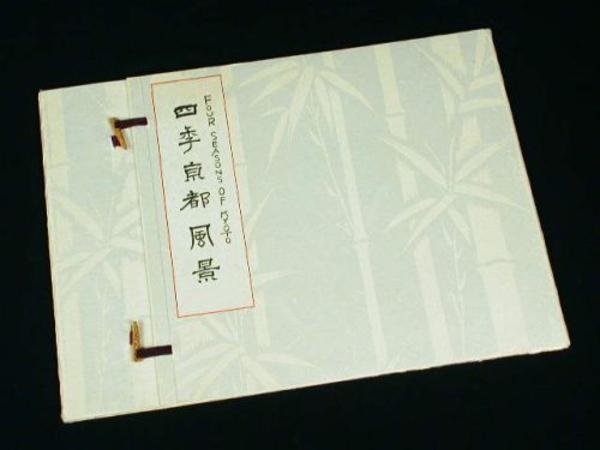
Heian Shrine in the Spring
Woodblock print
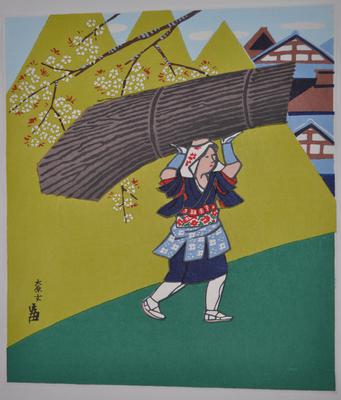
An Oharame Girl Carrying Firewood on Her Head
20th century
Woodblock print, ink and color on paper

April (Arashiyama Park, a Famous Scenic Resort)
四月 (嵐山)
second half 20th century
Woodblock print, ink and color on paper

June (Rainy Scene of the Sen-ke, Japanese Tea Ceremony Founder's House)
六月 (千家雨景)
second half 20th century
Woodblock print, ink and color on paper
Featured in Collections
Curated cross-cuts that include this print.
Frequently Asked Questions
Roses was created by Tomikichiro Tokuriki (徳力富吉郎).