
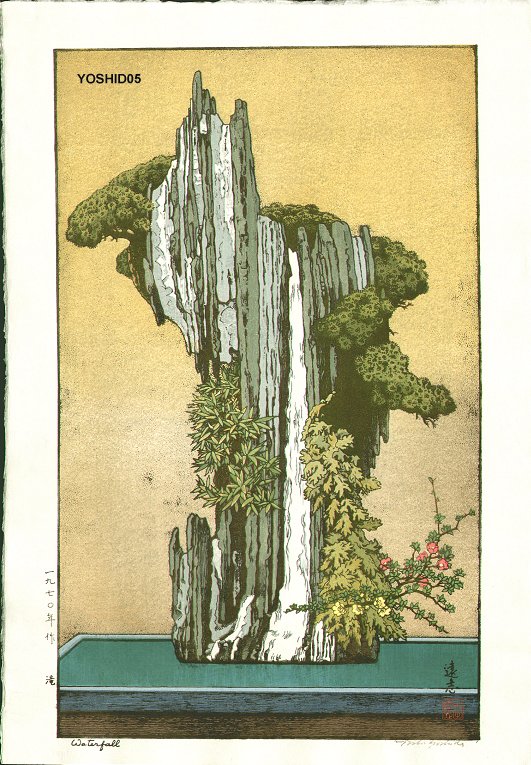
Shomyo Waterfall
- Medium:
- Mokuhanga (Japanese woodblock)
- Image courtesy of
- Saru Gallery
Description
Shomyo Falls in the mountains of Toyama Prefecture drops roughly 350 meters in four staged cascades and has been a meisho (famous place) subject in Japanese art since the medieval period. Tokuriki's print follows the conventional vertical oban format used for waterfall imagery, which lets the keyblock trace the cliff face from crest to plunge pool in a single tall composition. Prints of this type rely on bokashi gradation in the falling water — the printer wipes pigment unevenly across the block to suggest mist and spray — while the surrounding rock and foliage are built up with several color blocks registered against kento marks. The waterfall subject ties Tokuriki to the long lineage of meisho-e running through Hokusai's Shokoku Taki Meguri (A Tour of Waterfalls in the Provinces) and Hiroshige's vertical landscapes, while his palette and flatter spatial handling place him within the twentieth-century shin-hanga and sosaku-hanga revival of the form.
More Prints by Tomikichiro Tokuriki
Heian Shrine in the Spring
Woodblock print
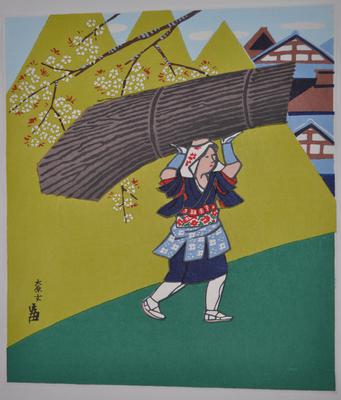
An Oharame Girl Carrying Firewood on Her Head
20th century
Woodblock print, ink and color on paper

April (Arashiyama Park, a Famous Scenic Resort)
四月 (嵐山)
second half 20th century
Woodblock print, ink and color on paper

June (Rainy Scene of the Sen-ke, Japanese Tea Ceremony Founder's House)
六月 (千家雨景)
second half 20th century
Woodblock print, ink and color on paper
More Waterfalls Prints


Featured in Collections
Curated cross-cuts that include this print.
Frequently Asked Questions
Shomyo Waterfall was created by Tomikichiro Tokuriki (徳力富吉郎).
Shomyo Waterfall depicts waterfalls.